
Summary
Today, the main source of gender gaps in high-income countries is related to family formation. After their first child is born, the labor market participation rates and earnings of mothers and fathers diverge sharply: mothers’ labor market participation and earnings decline relative to fathers’. This has substantial implications for mothers’ lifetime income and pension savings. But do women fully anticipate these costs when deciding how much to work as a parent? Our evidence suggests they do not. We show that randomly providing mothers with information about the long-term costs of reduced hours increases demand for financial tools and planned employment levels in the long term. Women who initially underestimate the costs of part-time employment adjust their work hours upwards one year after the intervention, as measured in employer records.
Our study combines descriptive evidence from a representative survey of Swiss mothers with a randomized experiment among Swiss mothers who work as public-school teachers. In our descriptive sample, 89% of mothers do not mention long-term financial factors when describing their labor supply decisions post-childbirth. Further, many mothers struggle to correctly assess the lifetime financial consequences of part-time work.
The field experiment among teachers then tests whether mothers change their labor supply decision when we provide objective information about these long-term costs. Mothers who receive an informational video and access to a personalized cost projection tool show higher demand for financial planning resources. Mothers who initially underestimate the costs of part-time work also increase their contracted employment levels by 7% one year after the intervention. If sustained over their careers, this adjustment would reduce gender gaps in lifetime income and pension wealth among teachers by nearly 20%.
These findings demonstrate that low-cost, scalable interventions can help mothers make more informed decisions about work and family. Incorporating information about long-term financial trade-offs into family policies—such as childcare expansion programs and parental leave—could strengthen their impact on maternal labor supply.
Main article
Today, the main source of gender gaps in high-income countries is related to family formation. After their first child is born, mothers’ labor market participation and earnings decline relative to fathers,’ with substantial implications for mothers’ lifetime income and pensions. Our evidence suggests that women do not fully anticipate these costs when deciding how much to work as a parent, and that randomly providing mothers with information about the long-term costs of reduced hours increases demand for financial tools and planned employment levels in the long term. Women who initially underestimate the costs of part-time employment adjust their work hours upwards one year after the intervention, as measured in employer records.
Mothers’ labor force participation and earnings decline sharply following the birth of a first child, resulting in gender gaps between parents that are large and highly persistent (Cortés and Pan, 2023; Kleven et al., 2019; Kleven et al., 2025). This divergence, the so-called child penalty, has been identified as the central driver behind remaining gender inequalities in the labor market in high-income countries (Betrand et al., 2018; Kleven et al., 2018). This “penalty” also implies profound financial consequences throughout a mother’s life cycle: Women miss out on a significant portion of their potential lifetime earnings and accumulate less savings for retirement. Yet, to date we know relatively little about how mothers make these pivotal and often sticky labor supply choices. Are mothers fully accounting for the long-term financial implications when deciding to reduce their work hours?
Mothers’ labor force participation and earnings decline sharply following the birth of a first child.
We open this black box and aim to shed light on mothers’ decision-making processes around their labor supply using two complementary approaches: a descriptive survey among a representative sample of Swiss mothers, and a large-scale field experiment among Swiss mothers working as public school teachers, in which a randomly selected group receives information about the long-term costs of reduced labor supply. The partnership with a regional educational department allows us to link participating teachers to administrative records of the employer, enabling us to study whether our treatment leads to actual changes in labor supply. Consistent with the intervention providing especially novel information for women who underestimate the cost of reduced work hours at baseline, we observe an increase in employment levels among this group one year after the intervention.
Switzerland has relatively conservative gender norms and one of the highest “child penalties” in earnings among high-income countries.
We conduct this study in Switzerland, a country that has relatively conservative gender norms and one of the highest “child penalties” in earnings among high-income countries. After childbirth, the vast majority of Swiss mothers return to the labor market working part-time. Similarly, female teachers drastically reduce their working hours when having children and do not substantially increase their level of employment later in their career. Compared to the average male teacher, this results in lifetime income losses of about 20% and a decrease in pension receipt of around 25%.
Long-term costs associated with reduced employment levels are not top of mind
With the descriptive survey, we first document that long-term financial factors are not top of mind when Swiss women are making labor supply decisions as a parent. In Figure 1, we show that when asked about the most important factors in their labor supply decision after having children, 89% of survey respondents do not mention any considerations related to long-term financial aspects, such as financial well-being, pension savings, or professional trajectories. We also elicit women’s concrete estimates of the short and long-term financial consequences of part-time work using a vignette. Many women struggle to correctly assess the life-time costs of salary and pension losses associated with reduced working hours. Women who underestimate the costs of working part-time — a group we refer to as “cost-underestimators” — are more likely to incorrectly believe that increasing work hours in the vignette would not be financially worthwhile. Women in this group are also more likely to indicate that they learned something new once we reveal the financial projections for the vignette. Taken together, our descriptive facts highlight that for most women, long-term financial considerations are simply not top of mind when making labor supply decisions. Moreover, the group of cost-underestimators may lack important pieces of information when making these choices.
Long-term financial factors are not top of mind when Swiss women are making labor supply decisions as a parent.
Figure 1: Factors Considered by Women in their Labor Supply Decision after Childbirth
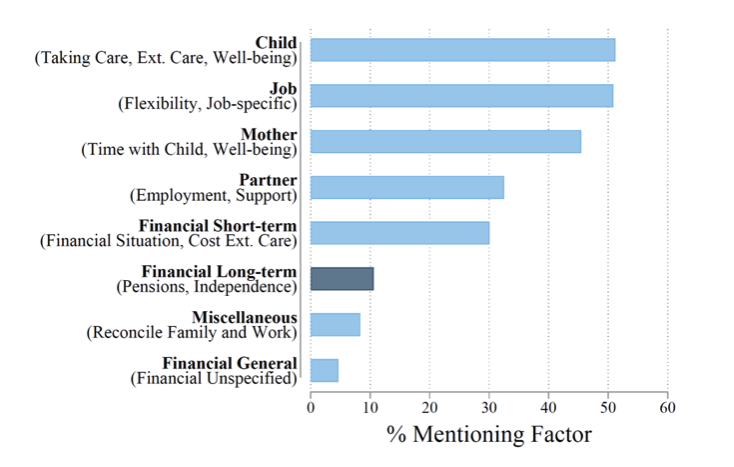
Note: This figure shows the percentage of women who mention a given topic when asked which factors they considered for their labor supply decision after the birth of their first child.
Figure 2: Cost-Underestimation Index and Financial Beliefs
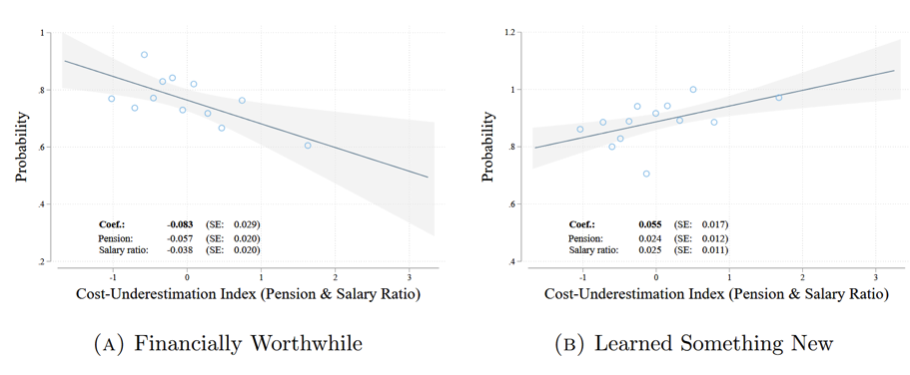
Note: This figure shows the correlation between the cost-underestimation index and respondents’ beliefs regarding the financial costs of part-time work. Panel A: Respondent correctly assesses the employment level increase in the part-time vignette as financially worthwhile. Panel B: Respondent indicates they learned something new in the survey. The cost-underestimation index is constructed by standardizing and aggregating with equal weight (.5) respondents’ deviations from projected pension receipt and part-time wage growth in the vignette of their respective education group.
Women in the treatment group plan to work more hours both in the upcoming academic year and up to ten years into the future.
Field experiment: The role of informational constraints
Based on these insights, we design a field experiment to test whether learning about the long-term financial consequences of part-time work impacts women’s financial planning and labor supply — two key levers to close gender gaps in lifetime earnings and pensions.
This randomized controlled trial involves 2,350 mothers working as public school teachers across around 480 schools in a German-speaking region of Switzerland. Teachers assigned to the treatment group receive an informational video discussing the long-term financial consequences of reduced working hours alongside access to an online tool that allows users to make individualized cost projections based on different (future) employment scenarios. The control group instead sees a placebo video with unrelated information. Our main comparison in this article is between teachers who randomly receive the treatment materials and teachers in the “pure control” group. “Pure control” group teachers work in schools in which we randomly assign all teachers to receive only the control materials (such that there is no learning about the treatment information from colleagues).
Figure 3: Treatment Effect on Financial Outcomes
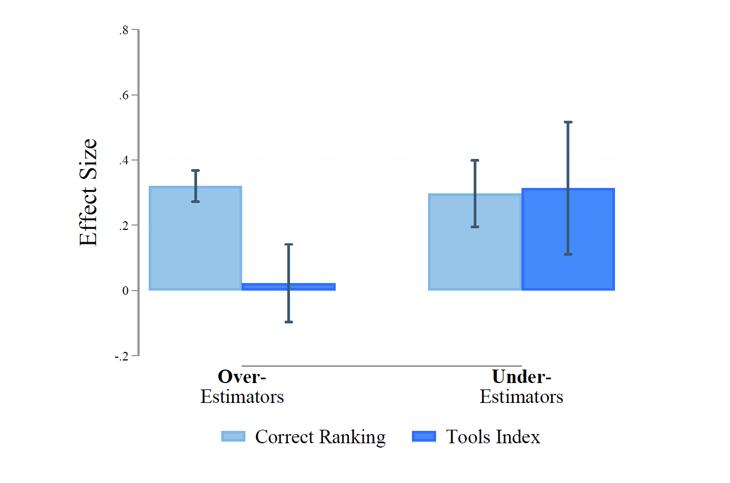
Note: This figure shows the treatment effect on financial outcomes by cost-underestimation at baseline. First bar (light blue): Correct ranking defined as respondent correctly assessing the relative magnitude of the financial implications of a labor supply increase using the part-time vignette. Second bar (darker blue): Tools Index, measures the willingness to sign up to receive different information materials and resources related to financial planning, including an incentivized sign-up for a financial consultation. All specifications use post-double-selection lasso to determine the set of controls and strata fixed effects.
We first document that treated mothers understand the information material and are able to correctly apply it: Treated women are substantially more likely to correctly rank the relative magnitude of long- and short-term financial costs related to reduced employment levels compared to women in the control group. This translates into higher demand for financial planning, with treated mothers being more likely to sign up for additional financial information and planning tools offered during the survey. Figure 3 shows these treatment effects separately by whether women initially underestimate the cost of part-time work (“Underestimators”) or not (“Overestimators”). In our teacher sample, about a quarter of respondents are cost-underestimators. While both groups show an increase of about 30 percentage points in learning the treatment material relative to the pure control group (light blue bar), this learning translates into higher demand for financial tools (darker blue bar) only among the group of cost-underestimators.
The expansion of contracted working hours among cost-underestimators represents a substantial increase of 7% relative to the control group.
Regarding labor supply, women in the treatment group plan to work more hours both in the upcoming academic year and up to ten years into the future. Again, cost-underestimators react more to the treatment and would like to adjust their labor supply more meaningfully: They report a 5 percentage point (or 6.3% over the control group mean) increase in employment level for the next academic year, and plan to maintain this higher employment level up to 10 years into the future.
Figure 4: Treatment Effect on Short-Term Labor Supply
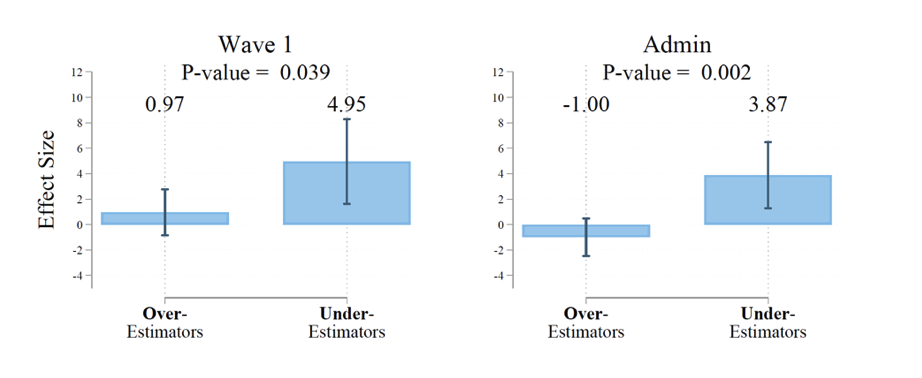
Note: This figure shows the treatment effect on short-term labor supply one year post-intervention by cost-underestimation status. Left panel: Change in next academic year’s planned employment level (Wave 1 survey data). Right panel: Change in actual employment level, administrative data. P-values for test of equality of coefficients between cost over- and under-estimators. All specifications use post-double-selection lasso to determine the set of controls and strata fixed effects.
To understand whether the shifts in intentions measured in the survey translate into shifts in actual behavior, we use administrative records of the employer to measure teachers’ realized labor supply choices one year after the intervention. Figure 4 shows that the change in planned labor supply for cost-underestimators observed in the survey directly after watching the treatment video (left panel) is mirrored by the changes observed in the administrative data (right panel). The expansion of contracted working hours among cost-underestimators represents a substantial increase of 7% relative to the control group. To put this magnitude into context, we can perform a back-of-the-envelope calculation: If we assume that — as indicated by longer-term labor supply plans — from age 40 onward, cost-underestimators increase their work hours by this amount, these women will on average accumulate an additional 130,000 CHF (162,500 USD) in lifetime income and 40,000 CHF (50,000 USD) in pension wealth. This would shrink the gender gaps in lifetime income and pension receipt among teachers by close to 20%.
An information campaign can help create meaningful behavioral change, especially among the least informed groups.
The results of our study highlight that some women may lack important pieces of information to make fully informed labor supply decisions when becoming a parent. A cost-effective and scalable information campaign can help close these information gaps and create meaningful behavioral change, especially among the least informed groups. Three caveats apply when generalizing our results: First, public school teachers have a deterministic salary scale with a clear mapping of hours into (current and future) pay. Mothers in other occupations may face substantially more uncertainty about how career investments translate into long-term payoffs. Second, in our setting and vignettes, increasing hours is always financially beneficial on net, even among lower earners. As recent evidence for the United States has shown, lower earning households may face binding credit constraints that prevent them from accessing childcare (Humphries et al., 2024). Third, we study a context characterized by teacher shortages, implying that our population does not face demand-side constraints and has considerable flexibility to adjust work hours on a yearly basis. Overall, our findings suggest that simple projections of the financial trade-offs associated with employment choices can be a valuable tool for decision making. More broadly, emphasizing the long-term financial implications within family policies — such as childcare expansions and subsidies — may make these reforms more effective in promoting mothers’ labor force participation.
This article summarizes ‘(Not) Thinking About the Future: Financial Information and Maternal Labor Supply’ by Ana Costa-Ramón, Michaela Slotwinski, Ursina Schaede, and Anne Ardila Brenøe, published online in The Quarterly Journal of Economics in January 2026.
Ana Costa-Ramón is at the University of Zurich. Michaela Slotwinski is at the University of Neuchâtel and University of Zurich. Ursina Schaede is at Tufts University. Anne Ardila Brenøe is at the University of Zurich.
References
Bertrand, M., Goldin, C., and Katz, L. F. (2010). Dynamics of the gender gap for young professionals in the financial and corporate sectors. American Economic Journal: Applied Economics, 2(3):228–255
Cortés, P. and Pan, J. (2023). Children and the remaining gender gaps in the labor market. Journal of Economic Literature, 61(4):1359–1409.
Costa-Ramón, A., Schaede, U., Slotwinski, M., and Brenøe., A. A. (2024). (Not) Thinking about the Future: Financial Information and Maternal Labor Supply. Working paper.
Humphries, J. E., Neilson, C., Ye, X., and Zimmerman, S. D. (2024). Parents’ Earnings and the Returns to Universal Pre-Kindergarten. National Bureau of Economic Research Working Paper w33038.
Kleven, H., Landais, C., and Egholt Sogaard, G. (2018). Children and gender inequality: Evidence from Denmark. VoxEU.org, 12 July.
Kleven, H., Landais, C., Posch, J., Steinhauer, A., and Zweimüller, J. (2019). Child penalties across countries: Evidence and explanations. VoxEU.org, 14 May.
Kleven, H., Landais, C., and Leite-Mariante, G. (2025). The child penalty atlas. Review of Economic Studies, 92(5):3174–3207.
Kuziemko, I., Shen, J., Pan, J., and Washington, E. (2018). Women’s anticipation of the employment effects of motherhood: Evidence and implications. VoxEU.org, 22 September.