Summary
Premerger notification is a nation’s first line of defense against anticompetitive mergers. Firms inform the government of their intent to merge and then wait for their proposed transaction to be reviewed. Yet in the US most mergers are exempt from this process because they fall short of size thresholds set by Congress. Currently, any merger valued below $134 million doesn’t need to be reported, and in many cases, much higher thresholds apply.
My research is based on two simple ideas. One is that governments can’t block what they don’t see. The other is that seemingly insignificant mergers can substantially reduce welfare in segmented industries. Together these ideas imply that mergers that would otherwise be blocked will avoid detection and escape enforcement merely because they are exempt from notification—an outcome I call “stealth consolidation” (Wollmann, 2019). A host of fiercely debated federal and state reforms address these concerns.
This paper studies premerger notification of US dialysis acquisitions from 1996 to 2017. Like many industries, dialysis has consolidated rapidly. During this period, thousands of facilities changed ownership, yet only half were reported to federal antitrust authorities. Unlike most industries, dialysis prices are mostly set by the government, so acquisitions of rival facilities reduce the incentive to compete on quality. Since patients are often already in poor health, preventing stealth consolidation could save lives.
The study combines data on market structure, antitrust enforcement, and patient health. I begin by describing patterns in the data. Next, I estimate a structural model of dialysis competition, enforcement, and agency costs. Finally, I use the estimates to predict what would have happened had all dialysis mergers proposed during the study period been reportable.
Three main findings emerge.
- Premerger notification is critical to effective antitrust enforcement. All else equal, exemption reduces the likelihood of enforcement by about 90%.
- Exempt acquisitions that concentrate ownership degrade quality, as evidenced by higher postmerger hospitalization and mortality rates.
- The benefits of expanding premerger notification exceed the costs by orders of magnitude. This reflects the deterrence effect of antitrust enforcement (i.e., rivals won’t try to merge if they know their deal will be blocked) as well as the efficiency of the Federal Trade Commission (FTC), which polices billions of dollars of dialysis transactions with very few resources.
My findings imply that the binding constraint on antitrust enforcement is timely information. For the reforms now being debated within and outside the U.S., the lesson is that notification requirements are not procedural formalities. They determine whether substantive antitrust law operates at all.
My findings also strongly suggest expanding premerger notification. While this paper is specific to dialysis, I expect benefits to far exceed costs in many industries, as the forces at work—the deterrent effect of enforcement and the low cost of review—are not unique to this one.
Main article
Lawmakers in the US and abroad are rewriting the rules that determine which mergers must be reported to antitrust authorities, yet there has been little evidence on what premerger notification contributes to enforcement or what expanding it would cost. Research on the US dialysis industry shows that mergers exempt from notification almost completely escape antitrust enforcement—consolidating local markets and degrading quality—while reported mergers are policed effectively and cheaply. Requiring that all dialysis mergers between 1996 and 2017 be reported would have generated roughly $2 billion in benefits at a cost of just $10 million.
For decades after Congress empowered antitrust authorities to prosecute anticompetitive transactions, rival firms continued to merge. To escape enforcement, they did so quietly and covertly, hoping that, by the time they were discovered, their operations would be so entwined as to make unwinding impractical. Congress addressed these so-called “midnight mergers” in 1976 with the Hart-Scott-Rodino Antitrust Improvements (HSR) Act, landmark legislation requiring premerger notification (Baer, 1997).
From its inception, the act exempted most mergers based on their size. Debates over the bill in the House and Senate reveal the reasoning: legislators believed that only very large mergers could harm competition enough to merit scrutiny. Yet this logic is flawed. Many economically important industries are highly segmented, meaning the markets in which firms compete are small. Dialysis, for example, is a $100 billion industry, but facilities serve local patient populations, so a market might consist of just two facilities, each worth only $3-5 million. In such areas, an acquisition of one facility by the other may seem small but eliminates competition entirely.
Several recent proposals and changes address the concern. For example, citing academic research (including the present paper), President Biden’s Federal Trade Commission (FTC) enacted rule changes that expanded premerger information collection. About a year later, a district court in Texas vacated the rule. However, President Trump’s FTC defended the rule and appealed the court’s decision, stating that “[r]egardless of the outcome of the litigation . . . the FTC is considering engaging in a new rulemaking process” (FTC, 2026). Such changes are not confined to the US. This year, for the first time, Australia mandates premerger notification rather than leaving it to the discretion of firms.
Governments can’t block what they don’t see.
State-level notification programs have also been created. Lawmakers in California, Oregon, New York, Illinois, and other states have established healthcare-specific notice and review programs, and legislatures of several other states have proposed them. Washington went further, enacting a healthcare-specific notification program as well as broader reporting requirements that apply to all industries—an approach that California and Colorado have since adopted.
US Dialysis
I study premerger notification in the dialysis industry. The problem with applying size-based thresholds in this setting is straightforward. Patients require multiple treatments each week, so they attend nearby facilities. Although US dialysis is a massive industry, individual markets are geographically narrow, competition is local, and facilities are relatively small. For most of my analysis period, one could acquire a rival chain with a dozen or more facilities and not be required to notify the FTC.
A lot is at stake. Dialysis prices are mostly set by Medicare, so facilities attract patients not by offering low prices but rather by offering high-quality healthcare. This means that if premerger notification exemptions reduce enforcement and ensuing stealth consolidation dulls incentives to compete, then providers will degrade quality.
My dataset spans 1996 to 2017. It combines information about facility ownership, market structure, and antitrust enforcement as well as patients’ facility choices and health outcomes. This period witnessed approximately 4,000 facility-level ownership changes. Only around half were reportable under the HSR Act. Around 300 were prevented by the FTC, which filed complaints and negotiated divestitures.
Premerger notification is essential to enforcement
The first question is whether premerger notification affects enforcement. Figure 1 provides an answer. It plots divestiture rates against the predicted changes in local concentration. The dashed line corresponds to reportable ownership changes, while the solid line corresponds to exempt ones.
Figure 1. Exempt mergers almost completely escape antitrust scrutiny
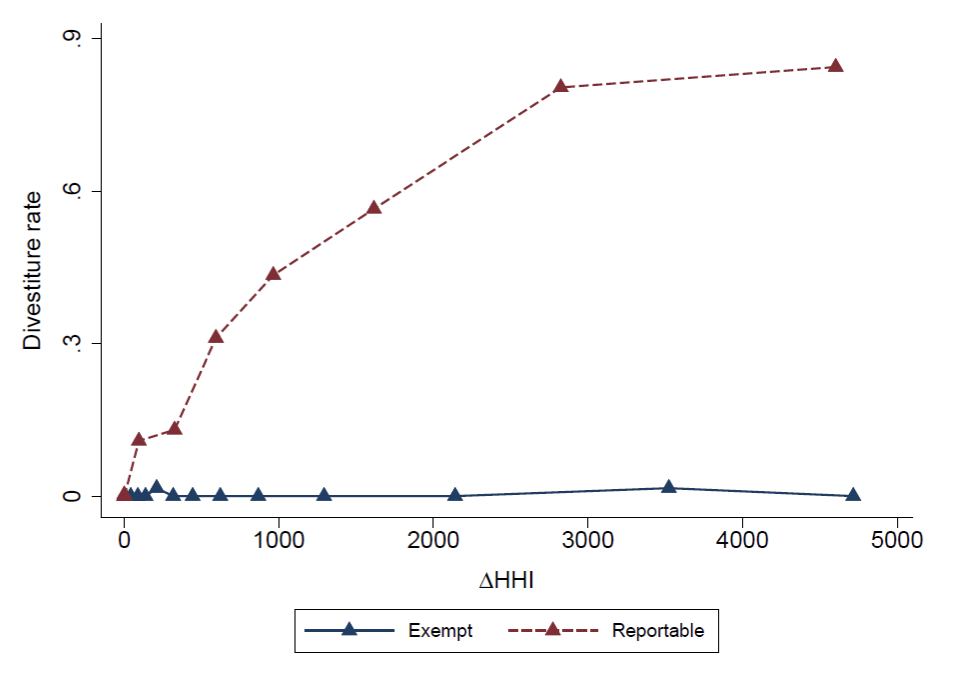
Notes: The figure plots divestiture rates on the vertical axis against predicted HHI changes on the horizontal axis. The unit of observation is a facilities acquisition. Data are placed in bins according to their horizontal axis values, and averages within the bins are displayed. The dashed line reflects reportable acquisitions; the solid line reflects exempt acquisitions. (HHI, short for Herfindahl–Hirschman index, measures concentration. The predicted HHI changes plotted here measure how much each acquisition would increase market concentration were it completed, holding everything else in the industry unchanged. More precisely, each predicted HHI change equals two times the market share of the target times the market share of the acquirer, where market shares are based on patient counts, computed just prior to the acquisition, and expressed as a percent. Larger predicted HHI changes correspond to more consolidation. For instance, in a market with ten equally sized firms, a merger of two of them yields a Delta HHI of 200, whereas in a market with 3 equally sized firms, a merger of two of them yields a Delta HHI of around 2,200.)
The contrast is stark. Among reportable acquisitions, enforcement rises sharply with predicted concentration. Acquisitions that barely change local concentration are almost never remedied, while those that would create highly concentrated markets face divestiture rates approaching 90%. Among exempt acquisitions, enforcement is essentially absent. Divestiture rates remain close to zero even for transactions that create duopolies and monopolies.
Exempt mergers almost completely escape antitrust scrutiny.
Notably, these findings empirically support claims made by the act’s sponsors. For example, Senator Hart stated in 1975, “[t]he only method the [DOJ] and FTC had to be aware of pending mergers or acquisitions was to read the general and trade press. In other words, if the Wall Street Journal missed one, so well may the FTC and the [DOJ]” (Hart, 1975).
Stealth consolidation degrades healthcare quality
The next question is whether the ownership changes that escape enforcement degrade quality. Figure 2 answers this. It reports estimates from staggered event studies, where each event corresponds to an ownership change. The figure compares quality before and after acquisitions, asking whether exempt acquisitions that substantially increase concentration lead to worse outcomes than other acquisitions. It measures quality using risk-adjusted survival rates in one panel and risk-adjusted hospitalization rates in the other.
Figure 2. Stealth consolidation degrades healthcare quality
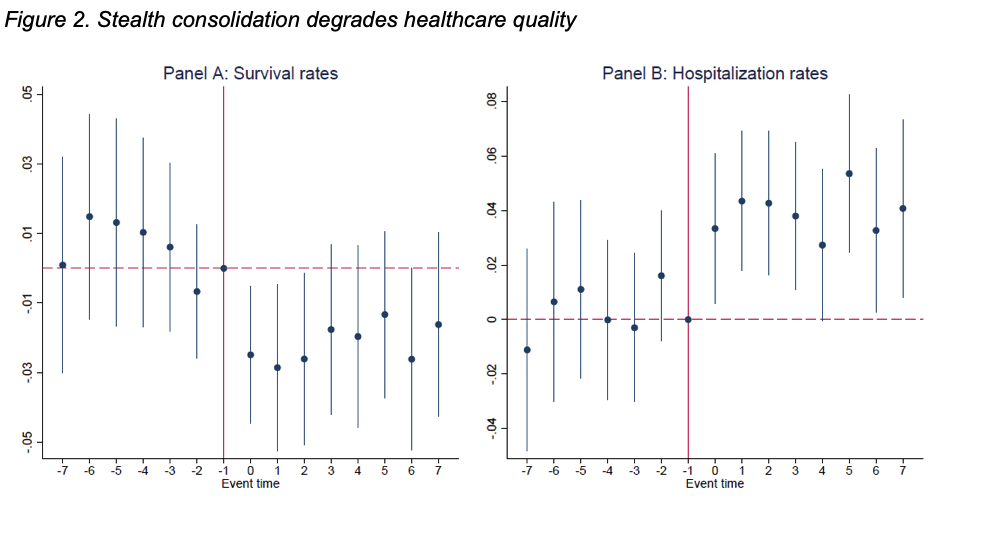
Notes: The figure plots event-study estimates for risk-adjusted quality on the vertical axis against event time on the horizontal axis. Quality corresponds to risk-adjusted survival rates in Panel A, whereas it corresponds to risk-adjusted hospitalization rates in Panel B. In both panels, event time is measured in years relative to the acquisition, so -1 in event time corresponds to the year just prior to each ownership change. (The event-study estimates reflect differences between exempt and reportable facilities acquisitions predicted to change HHI by large and small amounts. Here, predicted HHI changes over about 500 points are defined as “large,” while the remainder are defined as “small.”)
The pattern is clear. Leading up to exempt acquisitions that substantially increase concentration, health outcomes are stable, but shortly thereafter, quality deteriorates. Survival rates fall by 2 percentage points from a base of 86%, while hospitalization rates rise by 4 percentage points from a base of 64%.
Divestiture rates remain close to zero even for transactions that create duopolies and monopolies.
These findings align with existing research. Eliason (2022) relies on very different variation but similarly finds that local market power reduces dialysis quality. Cutler, Dafny, and Ody (2016) study mergers between national chains, which are large and therefore reportable. My findings imply that for this set of transactions, there should be no relationship between predicted consolidation and quality, since anticompetitive ownership changes are blocked. This is precisely what the authors find.
Benefits of expanding premerger notification far exceed costs
The descriptive evidence shows that premerger notification saves lives. Yet policy evaluation requires a comparison of benefits and costs. Expanding notification would require the government to review additional filings and investigate additional transactions, which means hiring and supporting additional staff.
To make this comparison, I estimate a structural model of dialysis competition, enforcement, and agency resource use. The model describes how patients choose facilities, how firms choose quality, how the FTC remedies mergers, and how agency inputs respond to changes in caseloads. I then use the model to retrospectively study what would have happened had all dialysis mergers between 1996 and 2017 been reportable.
Throughout the exercise, I proxy for quality using risk-adjusted survival rates. Survival is a natural choice, since it is reliably measured in my data, easily understood by a wide range of readers, correlated with other dimensions of quality, and unquestionably relevant to the welfare of patients. Of course, like most measures, it isn’t perfect. For instance, it might not capture certain ways in which acquisitions affect quality. As an example, consolidation might make it easier or harder for patients to schedule treatments.
Survival rates fall while hospitalization rates rise.
The benefits come from improved health outcomes. When I apply the enforcement rates historically faced by reportable mergers to exempt ones, many anticompetitive ownership changes are blocked. This prevents consolidation, preserves competition, increases quality, and saves lives, which are translated into dollars using the statistical value of a life year. The costs come from additional agency resources.
Expected benefits are approximately $2.1 billion. Expected costs are just $10 million. In short, the benefits of eliminating premerger notification exemptions in the dialysis industry between 1996 and 2017 could exceed the costs by orders of magnitude.
Why are costs so comparatively low? One reason is deterrence. Were exemptions eliminated, most harmful mergers would never be proposed in the first place. In turn, the agencies would not need to expend resources challenging them. Another reason is the efficiency of the FTC, which has effectively policed billions of dollars of dialysis mergers on an extremely tight budget.
Policy implications
My findings imply that the binding constraint on antitrust enforcement is timely information. In the subset of mergers where the FTC is notified of the transaction prior to closing, the agency enforces the law as Congress wrote it. Where it is not notified, even mergers to monopoly go unnoticed and unchallenged. For the reforms now being debated in Congress, the states, and abroad, the lesson is that notification requirements are not procedural formalities. They determine whether substantive antitrust law operates at all.
Expected benefits are approximately $2.1 billion. Expected costs are just $10 million.
My findings also strongly suggest expanding premerger notification. To be sure, this paper is specific to dialysis. Yet I expect benefits to far exceed costs in many industries, as the forces at work—the deterrent effect of enforcement and the low cost of review—are not unique to this one. Moreover, while my analysis abstracts away from compliance costs borne by firms, practical concerns need not arise. Legislators can easily establish a simpler disclosure system for small deals, trivializing the burden on merging parties while providing the agencies the information they need (Scott Morton, 2019).
This article summarizes “How to Get Away with Merger: Stealth Consolidation and Its Effects on US Dialysis” by Thomas G. Wollmann, which will be published in the Journal of Political Economy (forthcoming).
Thomas G. Wollmann is the Kelli Questrom Associate Professor in Markets, Public Policy, and Law at Boston University Questrom School of Business and a Research Associate at the National Bureau of Economic Research.
References
Baer, William J. 1997. “Reflections on Twenty Years of Merger Enforcement Under the Hart-Scott-Rodino Act.” Antitrust Law Journal, 65: 825.
Cutler, David M., Leemore Dafny, and Christopher Ody. 2016. “How Does Competition Impact Quality of Care? A Case Study of the U.S. Dialysis Industry.” Working paper.
Eliason, Paul J. 2021. “Market Power and Quality: Congestion and Spatial Competition in the Dialysis Industry.” Working paper.
Federal Trade Commission (FTC). “Federal Trade Commission and Department of Justice Seek Public Comment on the Premerger Notification and Report Form.” Press release, March 25, 2026.
Hart, Philip A. 1975. Remarks on the introduction of S. 1284, the Antitrust Improvements Act of 1975. Congressional Record, 94th Congress, 1st Session, March 22, 1975.
Scott Morton, Fiona. 2019. Testimony before the House Judiciary Committee, Subcommittee on Antitrust, Commercial and Administrative Law, “Diagnosing the Problem: Exploring the Effects of Consolidation and Anticompetitive Conduct in Healthcare Markets.”
Wollmann, Thomas G. 2019. “Stealth Consolidation: Evidence from an Amendment to the Hart-Scott-Rodino Act.” American Economic Review: Insights, 1(1): 77–94.