
Summary
Apprenticeships play an important role in the school-to-work transition in many countries, combining on-the-job training with classroom instruction to equip young people with occupation-specific skills. This specificity can be a virtue but can also create a potential vulnerability; if workers do not end up working in the occupation they trained in then they may not be able to fully use their skills.
This study uses rich administrative data to study the prevalence and wage consequences of this kind of occupational mismatch in Germany, a setting where the majority of school leavers enters an apprenticeship—and where the stakes of getting matches right may therefore be particularly high.
It is surprisingly common for workers who hold apprenticeships to work outside their training occupation. An average of 40% of individuals in the dataset do so, though rates vary significantly across training and occupation categories. Workers are also more likely to be mismatched the more time they have spent in the labor market.
Establishing the causal effect of occupational mismatch on wages is not straightforward, since workers who end up outside their training field may differ systematically from those who remain in ways that are difficult to observe. To address this challenge, the study develops an empirical strategy using vacancy data. The idea is that fluctuations in demand across all occupations influence occupational choices because workers compare the options that are available to them. The econometric approach is demanding. Roughly speaking, the study uses a regression model in which log wages depend on the match between the current occupation and the type of training a worker received.
The headline finding is stark: lacking training in one’s occupation carries an average wage penalty of 14%, the equivalent of losing roughly two years of work experience. While these workers partly catch up over time, a substantial penalty remains even after 20 years.
The amount of the penalty depends on what type of training is combined with what type of occupation. Workers who move to an occupation that is relatively similar in terms of tasks to their training suffer a smaller penalty; those who move to an occupation that is very different from what they trained for suffer a larger one.
Given the sizeable penalty, why do workers end up mismatching? They may simply not be able to find a job in their original training field or, alternatively, they may receive new information about higher wages in other occupations, or about their preferences and talents. The findings in the study suggest that the latter is most important in explaining mismatch.
So what can policy do? Interventions to improve the information available to young school leavers when they make their training choice could have some success, but future changes to local labor demand can be hard to anticipate. Retraining is another option, and this study suggests that doing so would pay off for many workers—especially those with long working lives ahead of them.
These findings—which carry lessons for countries well beyond Germany—suggest that policymakers should pay close attention not only to the quality of the specific skills instilled during training, but also to the flexibility that is allowed for within those training systems.
Main article
Apprenticeships play an important role in the school-to-work transition in many countries, but what happens when graduates end up working in a field that differs from their training? This study finds that four in ten German apprenticeship graduates find themselves in this situation, and that doing so carries a substantial wage penalty. The penalty is not uniform: it grows as the tasks required in the worker’s actual job become more different from those encountered during training. These findings have important implications for the design of education programs. Expanding retraining opportunities, in particular, could help workers who find themselves with the wrong training to rebuild their human capital in a field better suited to them.
Preparing young people for the labor market is an important concern for policymakers around the world, and countries differ markedly in the types of skills they provide to their school leavers. Some, including the United States and the United Kingdom, rely predominantly on university education, which equips graduates with a relatively general body of knowledge intended to be applicable across a wide range of jobs. Others, including Germany, Austria, and Denmark, place much greater emphasis on apprenticeships—a form of vocational education that combines on-the-job training with classroom instruction to develop skills that are specific to a particular occupation.
The specificity of apprenticeship skills is often seen as a virtue: graduates enter the labor market with practical competencies that are immediately deployable, facilitating the transition into the labor market. However, the very specificity that makes apprenticeship training valuable also creates a potential vulnerability. If workers do not end up working in the occupation they trained in—perhaps because local labor demand has shifted, or because their initial occupational choice turned out to be a poor match for their preferences—they may not be able to fully use their skills. The result may be a form of mismatch that imposes lasting costs on workers.
The specificity of apprenticeship skills is often seen as a virtue but also creates a potential vulnerability.
The research summarized here uses rich administrative data to study the prevalence and wage consequences of this kind of occupational mismatch in Germany, a setting where the majority of school leavers enters an apprenticeship each year. The study first documents that a large share of workers who complete an apprenticeship work in an occupation that differs from their training. It then estimates the associated wage penalties, finding that lacking training in one’s occupation comes with important costs that become larger the less related the skills acquired during the apprenticeship are to the occupation. These findings point to a clear policy implication: since training choices are made at a young age when the future is hard to anticipate, expanding access to retraining later in life could help the many workers who end up working outside the occupation they trained for.
The German apprenticeship system
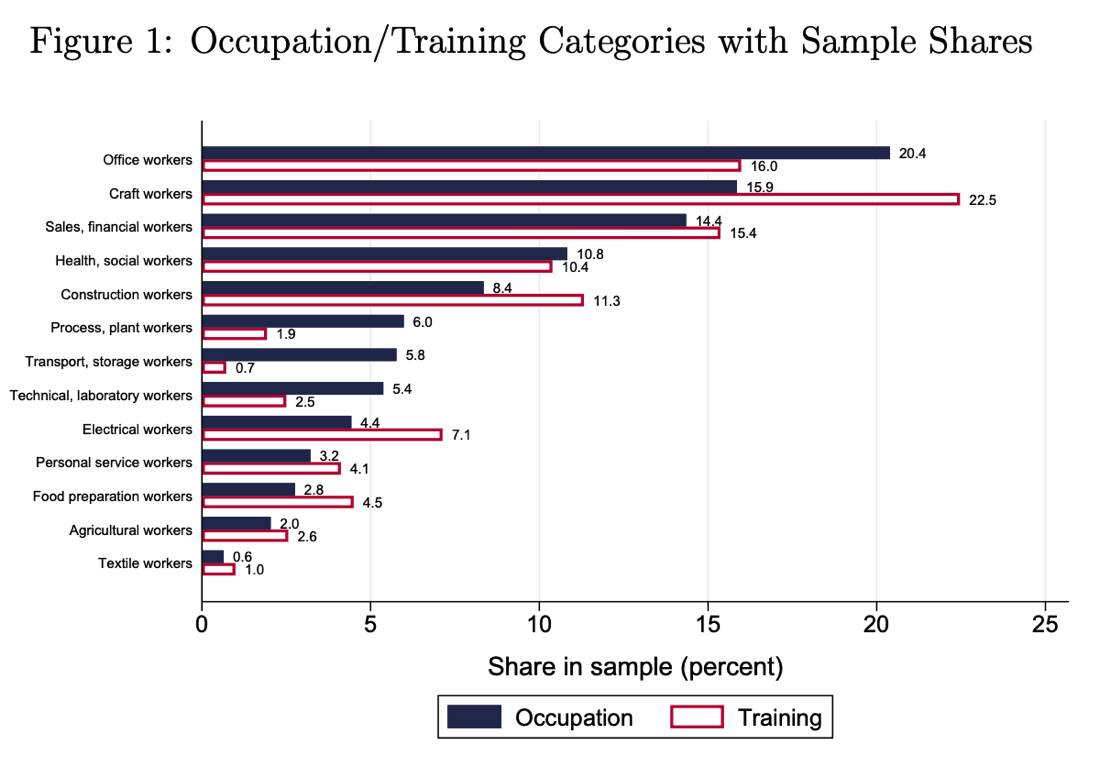
Germany’s apprenticeship system is one of the most prominent models of vocational education in the world. Each year, the majority of school leavers enter an apprenticeship in one of many so-called “recognized training occupations,” spanning areas as diverse as office work, construction and social work. Figure 1 shows the full list of occupation groups used in the study. The system is referred to as “dual” because training takes place in two settings: the firm, which provides practical, on-the-job instruction, and the vocational school, which delivers relevant theoretical skills. Training lasts around three years, culminating in a standardized examination set and administered by industry-specific chambers.
An average of 40% of individuals work in an occupation different from the one they trained in.
Compared to other high-income countries, Germany’s economy relies heavily on vocational rather than academic education. Cross-country data from the OECD shows that the prevalence of vocational training in a country correlates with lower levels of skill portability: the more a country relies on vocational routes, the more likely its workers are to work in occupations related to their education field and the less likely they are to change jobs. This makes Germany an especially informative setting for studying the consequences of mismatch because the stakes of getting the match right may be particularly high.
The extent of occupational mismatch
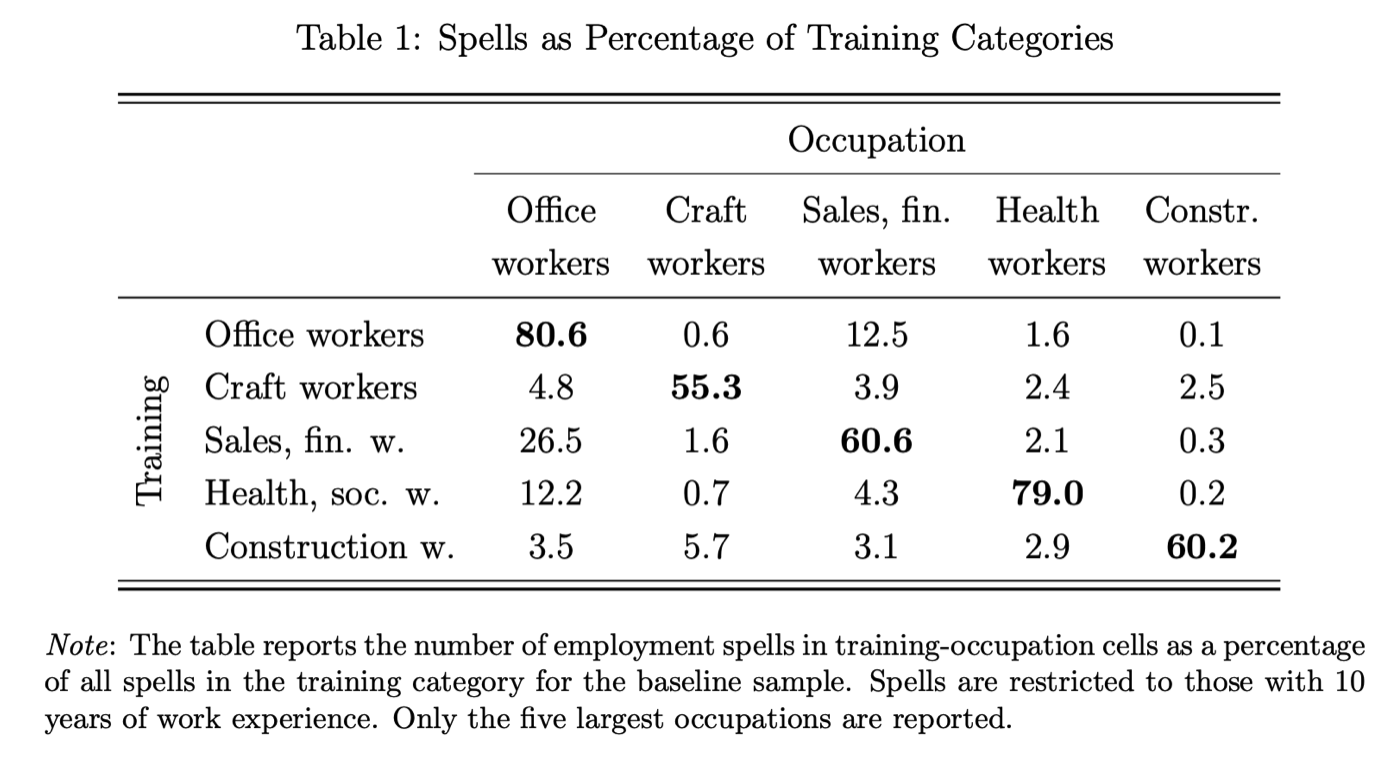
How common is it for workers who hold apprenticeships to work outside their training occupation? Using administrative data from German social security records for a large representative sample, the study finds that the answer is: surprisingly common. Based on the occupation groups shown in Figure 1, an average of 40% of individuals work in an occupation different from the one they trained in. This average combines very different rates of mismatch across training and occupation categories. Table 1 shows, for instance, that 80.6% of trained office workers are in office worker jobs. This means that only about 19.4% are mismatched. In contrast, the rate of mismatch is almost 45% for craft workers. The study also shows that workers are more likely to be mismatched the more time they have spent in the labor market.
The extent of mismatch appears striking. Whether this mismatch is costly depends on the nature of the skills acquired during training: if knowledge transfers readily across occupations, working outside one’s training field need not entail any penalty. If, on the other hand, the skills are highly specific, workers who end up outside their occupation may find themselves at a disadvantage relative to colleagues who trained for the job they are doing.
Estimating the cost of mismatch
Establishing the causal wage effect of occupational mismatch is not straightforward. Workers who end up outside their training field are not a random sample: they may differ systematically from those who remain in their training field in ways that are difficult to observe. For example, workers who realize later in life that they are particularly talented in a field they did not train in may be more likely to switch to that new field and will earn higher wages there due to their talent, regardless of their original training. Naïve comparisons of the wages of matched and mismatched workers will therefore tend to produce estimates that cannot be interpreted causally.
Part of the contribution of this study is to make estimation of the wage effects of this mismatch feasible.
To address this challenge, the study develops an empirical strategy using vacancy data. The idea is that fluctuations in demand across all occupations influence occupational choices because workers compare the options that are available to them. For example, an individual deciding whether to work as a construction worker may be influenced by occupational demand in craft occupations as they weigh the relative advantage of working in construction. Because lower demand in crafts may push people into working in construction for reasons that are unrelated to an individual’s productivity, this source of variation makes it possible to isolate the causal effect of combining training in an occupation with work across different occupations.
The econometric approach is demanding: because there are many possible training-occupation combinations, part of the contribution of the study is to make estimation of the mismatch effects feasible, building on the methods developed in two important papers by Lee (1983) and Dahl (2002). Roughly speaking, the study uses a regression model in which log wages depend on the match between the current occupation, indexed by (k), and the type of training a worker received, indexed by (j). This makes it possible to quantify the wage penalty from working in an occupation that does not match the worker’s training.
In the main regression, the paper estimates a summary effect of mismatch using a variable that is equal to one if a worker’s occupation (k) matches their training type (j), and equal to zero otherwise. The effect is estimated controlling for constant factors influencing wages relating to the worker, their current occupation, and the region and year using corresponding “fixed effects.” The estimation also controls for the effect of a worker’s years of experience in the occupation and the state of the labor market in their current occupation using vacancy data. Critically, a control function is included to account for selection into the occupation and training pair.
The regression model is of the form:

The term captures how wages change when a worker’s training (j) matches their occupation (k) relative to when the worker is mismatched—when is equal to one rather than zero. It therefore gives an indication of the mismatch penalty.
The wage penalty for mismatch
The headline finding is stark: the estimate for the match term is around 14%, implying that lacking training in one’s occupation carries an average wage penalty of 14%, which is equivalent to losing roughly two years of work experience. Over time, workers who do not have the appropriate training for an occupation partly catch up with their adequately trained co-workers by learning on the job, but a substantial penalty remains even after 20 years of working in an occupation.
Lacking training in one’s occupation carries an average wage penalty of 14%, the equivalent of losing roughly two years of work experience.
One might expect the amount of the penalty to depend on what type of training is combined with what type of occupation. Workers trained in an occupation that is relatively similar to the one they end up working in—somebody trained as an office worker working as a financial worker, say—may be able to use many of their skills. On the other hand, somebody trained in an occupation that is very different from the one they end up working in—the same person trained as an office worker now working as a craft worker—may not be able to use many of their skills. The study looks at this by estimating not just average match effects , but also separate match effects for each training-occupation combination. To measure how different a worker’s current job is from their training, the study draws on survey data covering the tasks typically performed across all occupations. The results show that the wage penalty increases systematically with this difference. Workers who move to an occupation that is relatively similar in terms of tasks to their training suffer a smaller penalty; those who move to an occupation that is very different from what they trained for suffer a larger one.
Mechanisms and implications
What explains these findings, and what do they imply for policy? At the heart of the paper’s interpretation is the concept of occupation-specific human capital—the idea, rooted in labor economic theory, that some skills are productive only in particular contexts and cannot be fully carried into other occupations (e.g., Kambourov and Manovskii (2009), Gathmann and Schönberg (2010)). If the skills acquired during an apprenticeship are specific in this sense, then a worker who ends up outside their training field may genuinely have fewer productive capabilities relative to a trained incumbent in the job they are doing.
Workers who move to an occupation that is very different from what they trained for suffer a larger penalty.
Given this, why do workers still end up mismatching? There may be multiple reasons. They may simply not be able to find a job in their original training field or, alternatively, they may receive new information about higher wages in other occupations, or about their preferences and talents. The findings in the study suggest that the latter is most important in explaining mismatch. School leavers are typically still very young when making a choice about which occupation to train in, so it is hard to fully anticipate what the future will bring. Later in life, they may realize that there are better job opportunities in other fields or that they would prefer working in a different occupation—and, as a result, make the switch.
So what can policy do? One possibility is to improve the amount of information available to young school leavers when they make their training choice. For instance, teaching young people about job opportunities or expanding internship opportunities could lead to more informed choices. Some existing research in other contexts suggests that such information treatments can be successful (e.g., Wiswall and Zafar (2015)) but without testing for the effectiveness of specific programs in the given context, it is difficult to put a number on how much mismatch one might be able to prevent. What’s more, some future changes to local labor demand may simply be very hard to anticipate, even for policymakers.
Retraining workers will often pay off as many leave their training field early on in their careers.
An alternative route that the paper explores is to think about retraining opportunities. Using estimates from other sources of how much retraining would cost and estimates from the study of the benefit of retraining (avoiding the 14% wage penalty!), it is possible to ask: would retraining workers pay off? The short answer is: yes, for many workers. This is because many leave their training field early on in their careers with long working lives ahead of them.
The paper’s findings carry lessons that extend well beyond Germany. Many countries have recently expanded or are considering expanding their vocational training systems, often citing the German system as a role model. The research summarized here suggests that policymakers should pay close attention not only to the quality of the specific skills instilled during training, but also to the flexibility that is allowed for within those training systems.
This article summarizes “Training Specificity and Occupational Mobility: Evidence from German Apprenticeships,” by Dita Eckardt, published in Econometrica in May 2026.
Dita Eckardt is at the Department of Economics at Warwick University.
References
Dahl, Gordon B. 2002. Mobility and the Return to Education: Testing a Roy Model with Multiple Markets. Econometrica, 70(6), 2367–2420.
Gathmann, Christina, & Schönberg, Uta. 2010. How General is Human Capital? A Task-Based Approach. Journal of Labor Economics, 28(1), 1–49.
Kambourov, Gueorgui, & Manovskii, Iourii. 2009. Occupational Specificity of Human Capital. International Economic Review, 50(1), 63–115.
Lee, Lung-Fei. 1983. Generalized Econometric Models with Selectivity. Econometrica, 51(2), 507–512.
Montt, Guillermo. 2015. The Causes and Consequences of Field-of-Study Mismatch: An Analysis using PIAAC. OECD Social, Employment and Migration Working Papers No. 167, OECD Publishing, Paris.
OECD. 2024a. Education GPS dataset: Educational attainment and labour-force status. Available at http://gpseducation.oecd.org/, accessed on 2024-01-29.
OECD. 2024b. OECD.Stat dataset: Employment by job tenure intervals – frequency. Available at https://stats.oecd.org/, accessed on 2024-01-29.
vom Berge, Philipp, Burghardt, Anja, & Trenkle, Simon. 2013. Sample of Integrated Labour Market Biographies. Regional File 1975-2010 (SIAB-R 7510). (FDZ-Datenreport 09/2013 (en)), Nuremberg, 73 S.
Wiswall, Matthew, & Zafar, Basit. 2015. Determinants of College Major Choice: Identification using an Information Experiment. The Review of Economic Studies, 82(2), 791–824.