
Summary
Despite the European Union’s free movement of goods, capital, services, and workers, wage differences across European Member States remain large, and cross-border migration rates remain modest.
Most research on European integration focuses either on trade in goods or on permanent migration. Yet over the past two decades, another channel of labor mobility has expanded rapidly: under the EU’s posting policy, firms can temporarily send their employees to perform a service contract in another member state. Posting has evolved into one of the largest temporary labor mobility schemes worldwide. This paper uses a newly assembled administrative datasets to study both the scale of posting and its economic consequences.
The first finding is that posting substantially increased cross-border labor mobility within Europe, leading to increased labor market integration in sectors long viewed as sheltered from international competition. Using a dynamic difference-in-differences design around the staggered liberalization of posting following successive rounds of EU enlargement, I find that lifting posting restrictions increased bilateral posting flows by roughly 500 percent in the year of liberalization, with effects that persist for at least a decade. Importantly, the liberalization of posting did not crowd out standard migration. Posted workers account for about 2 percent of the EU workforce, and annual posting flows are roughly 60% larger than within-EU conventional migration flow.
Why did posting expand overall factor mobility in the single market, despite the absence of regulatory barriers to trade and migration? Firms can benefit from lower regulatory costs and can also partially overcome the informational, financial, and institutional barriers that appear to constrain workers’ permanent migration.
This greater integration, however, had distributional consequences. Comparing more and less exposed regions of France before and after EU enlargement, the estimated effect corresponds to roughly a three percent reduction in domestic employment over the following decade in the more exposed regions. Domestic wages, by contrast, remain largely unchanged. The negative employment effects for French workers arise because firms can hire posted workers for around 30 percent less than comparable domestic workers performing similar tasks. The posting framework—and in particular the stipulation that posted workers are governed primarily by home-country labor law and subject only to minimum wage rules in the destination country—creates a segmented labor market in high wage receiving countries, allowing firms to adjust labor costs through substitution rather than wage cuts.
Using firm-level tax data from Portugal, I show that when firms begin supplying services abroad through posting for the first time, their performance improves sharply. These tend to be relatively small firms operating in sectors considered local and non-tradable, rather than the large, highly capital-intensive manufacturing exporters that typically dominate international trade—a finding that sheds light on the distributional effects of globalization.
Economic gains are not evenly distributed within these firms. Although posted workers earn higher wages when working abroad, these increases are smaller than the corresponding rise in firm profits. In addition, the wage gains themselves are driven by destination-country binding minimum wages rather than by bargaining over the export surplus, a finding that illustrates the importance of institutional design in shaping the distribution of gains.
Overall, posting deepened integration, created new export opportunities for small service firms, and led to efficiency gains. However, the expanded competition also negatively affected employment in exposed regions.
Main article
Despite the EU’s freedom of movement, wage differences across Member States remain large, and cross-border migration rates remain modest. Where most research on the movement of people focuses on permanent migration, this research assembles a new administrative dataset that enables analysis of the economic effects of the EU’s posting policy, a little-studied temporary labor mobility channel that has expanded rapidly over the past two decades. Findings suggest that temporary, firm-mediated mobility can substantially increase factor mobility even in the context of open borders. The posting policy has expanded competition into previously sheltered sectors, generating efficiency gains and new export opportunities for small service firms, but also negatively affecting employment in exposed regions.
European integration rests on four freedoms: the free movement of goods, capital, services, and workers. In principle, these economic freedoms should foster convergence across countries. In practice, wage differences across European Member States remain large, and cross-border migration rates remain modest.
Most research on European integration focuses either on trade in goods or on permanent migration. Yet over the past two decades, another channel of labor mobility has expanded rapidly: the posting of workers.
Under the EU’s posting policy, firms can temporarily send their employees to perform a service contract in another Member State. A Polish construction firm can build in France and a Portuguese transport firm can operate in Germany. Posted workers physically work abroad but remain legally employed, and taxed, in their home country. Although posting emerged from the liberalization of trade in services, it has evolved into one of the largest temporary labor mobility schemes worldwide, enabling international competition in sectors and jobs long viewed as “non-tradable.’’
Wage differences across European member states remain large, and cross-border migration rates remain modest.
This paper studies the economic consequences of this policy. It addresses three main questions. First, did the liberalization of posting significantly increase labor mobility within Europe, and why? Second, how did the expansion of posting affect employment and wages in receiving countries? Third, how were the gains from posting shared between workers, firms, and governments in sending countries?
Answering these questions sheds light on how globalization operates in sectors previously considered “non-tradable,” and how institutional rules can shape the distribution of gains from international integration.
New datasets on posting
Reliable data on posting have historically been scarce. To address this gap, I assemble new administrative datasets to study both the scale of posting and its economic consequences.
First, I collect information on social security forms issued for every posting assignment within the EU. These data allow me to construct a complete bilateral matrix of posting flows between EU countries from 2005 to 2019. Second, I link posting registries with employer–employee data in two major receiving countries (France and Belgium). These data make it possible to observe domestic and posted workers within the same firms, with information on wages, occupations, and employment histories. Third, I use firm-level administrative tax data from Portugal and Luxembourg to examine how firm-level gains from posting are shared between capital-owners and workers.
Effects on Factor Mobility and International Competition in Non-Tradable Sectors
The first finding is that posting substantially increased cross-border labor mobility within Europe, leading to increased labor market integration in sectors long viewed as sheltered from international competition.
I study the staggered liberalization of posting following EU enlargements in 2004, 2007, and 2013. When Eastern European countries joined the EU, restrictions on cross-border service provision were lifted at different times across destination countries. This staggered timing generates quasi-experimental variation that allows me to estimate the causal impact of posting liberalization on posting flows, and other channels of labor market integration. Using a dynamic difference-in-differences design around the timing of liberalization, I find that lifting posting restrictions increased bilateral posting flows by roughly 500 percent in the year of liberalization, with effects that persist for at least a decade. Importantly, the liberalization of posting did not crowd out standard migration. When posting is liberalized between two EU countries, conventional migration between these countries does not change; conversely, when conventional migration is liberalized, posting flows remain unaffected.
I assemble new administrative datasets to study both the scale of posting and its economic consequences.
The evidence therefore suggests that posting expanded overall factor mobility in the single market, despite the absence of regulatory barriers to trade and migration. How? Posted workers appear to face informational, financial, and institutional barriers that constrain their permanent migration. Firms can partially overcome these constraints by coordinating recruitment, absorbing mobility costs, and reducing uncertainty for workers. At the same time, posting allows firms to operate abroad while remaining subject primarily to origin-country labor law and social security contributions. By lowering both worker-side migration frictions and firm-side regulatory costs, the posting policy makes cross-border labor movements viable in situations where permanent migration would not occur.
In quantitative terms, posted workers account for about 2 percent of the EU workforce, and annual posting flows are roughly 60% larger than within-EU conventional migration flow (Figure 1). Posted workers are mostly sent from Eastern and Southern European countries where wages are lower, to high-wage countries like France, Belgium, or Germany. Posting is concentrated in sectors traditionally viewed as non-tradable, such as construction, trucking, cleaning, agriculture, and other face-to-face services. Today, cross-border service provision through posting represents nearly 30 percent of intra-EU trade in services, a larger share than trade in finance or technology services (Figure 1).
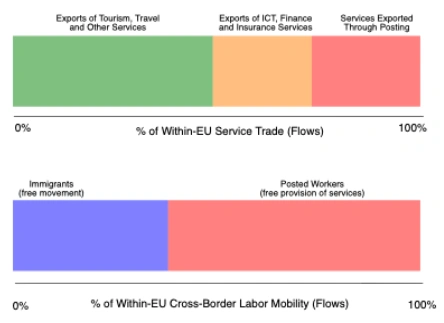
Figure 1: Contribution of the Posting Policy to Trade in Factors within the EU
Notes: This figure shows the contribution of the cross-border supply of services through posting to trade in services within the EU in 2017 (top panel), using trade data. The bottom compares the number of posted workers, measured in full-time equivalents, in 2017 to the number of conventional immigrants moving from one EU country to the other in the same year.
Employment Effects in Receiving Countries
This greater integration, however, had distributional consequences. To study the labor market effects of posting flows, I focus on France and exploit variation in regional exposure to posting following EU enlargement. Regions with stronger pre-existing ties to foreign service providers experienced larger inflows of posted workers after liberalization.
Posting substantially increased cross-border labor mobility within Europe, leading to increased labor market integration in “non-tradable” sectors.
Comparing more and less exposed regions before and after the shock, I find that employment in exposed sectors declined relative to less exposed areas (Figure 2). The estimated effect corresponds to roughly a three percent reduction in domestic employment over the following decade in the more exposed regions. Domestic wages, by contrast, remain largely unchanged. The negative employment effects extend beyond native workers. Earlier immigrant cohorts competing in similar segments of the labor market also experienced employment declines. Adjustment to the posting shock does not appear to have occurred through large-scale geographic mobility or sectoral reallocation, even ten years after the shock. Instead, it primarily reflects lower employment for domestic workers and lower labor force participation within exposed sectors.
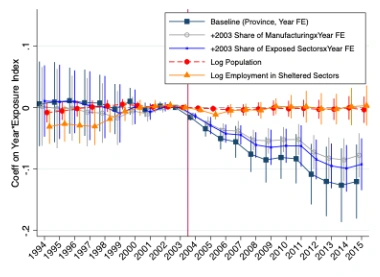
Figure 2: Log French Employment and Population in Regions Exposed to Posted Workers
Notes: This figure shows the evolution of (log) French employment in French regions (departments) more exposed to posted workers, after that the 2004 EU enlargement allowed firms in Eastern Europe to send posted workers to Western EU countries. The blue series focus on employment in exposed sectors, the orange series employment in sheltered sectors, and the red series focus on (log) population.
The negative employment effects for French workers arise because firms can hire posted workers at substantially lower cost. Using linked employer-employee data from France and Belgium, I study wage-setting within firms that purchase posting services. Within the same workplace, posted workers earn roughly 30 percent less than comparable domestic workers performing similar tasks. In contrast, immigrant workers hired under a domestic contract at the same firms are paid at similar wages than natives. Firms cannot differentiate wages between similar natives and immigrants under domestic contracts, while comparable posted workers performing the same tasks earn substantially less.
The negative employment effects for French workers arise because firms can hire posted workers at substantially lower cost.
Posted workers remain legally employed by the exporting firm in their home country and are governed primarily by home-country labor law, subject only to minimum wage rules in the destination country. Before recent reforms, they were not covered by the full set of collective agreements and firm-level wage-setting rules that apply to domestic employees. This contractual difference is central to understanding both wage-setting for posted workers and the negative employment effects for native workers. Firms cannot easily reduce the wages of incumbent domestic employees without renegotiating contracts or violating collective agreements. Nor can they legally pay immigrants less than natives under domestic contracts. By contrast, they can hire posted workers at lower cost. The posting framework therefore creates a segmented labor market in high wage receiving countries, allowing firms to adjust labor costs through substitution rather than wage cuts.
The key implication is that the labor market effects of international mobility depend not only on the size of flows but also on how mobility is organized legally. Posting differs from conventional migration precisely because it creates an alternative contractual channel through which firms can adjust labor costs. That difference explains why the expansion of posting generates employment losses in exposed sectors, but no substantial wage declines among domestic workers.
Gains in Sending Countries—and for Whom?
While employment declined in exposed regions of receiving countries, the economic effects in sending countries are substantially different.
Posting extends export opportunities beyond large industrial firms to small, labor-intensive service sectors.
Using firm-level tax data from Portugal, I examine what happens when firms begin supplying services abroad through posting for the first time. When firms start exporting services via posting, their performance improves sharply: sales rise substantially, employment expands, and profits increase significantly. Consistent with the interpretation that the economic gains are caused by posting, the improved economic performances also stop when the firm stops accessing foreign customers through posting.
While the finding that exporters benefit from international trade is unsurprising, the firms that expand through posting are not the large, highly capital-intensive manufacturing exporters that typically dominate international trade. They are relatively small firms operating in sectors such as painting, residential construction, road transportation, and temporary employment services, sectors traditionally considered local and non-tradable. Yet the magnitude of their gains is comparable to those documented for goods exporters in the same context. Posting thus opens export opportunities to firms that would otherwise be restricted to domestic demand.
Institutional design matters for both how gains are distributed between workers and firms and the employment effects in receiving labor markets.
This finding matters for understanding the distributional effects of globalization. Posting extends export opportunities beyond large industrial firms to small, labor-intensive service sectors. But the gains are not evenly distributed within these firms. First, although posted workers earn higher wages when working abroad, these increases are smaller than the corresponding rise in firm profits (Figure 3). A substantial share of the surplus generated by cross-border service provision accrues to capital owners.
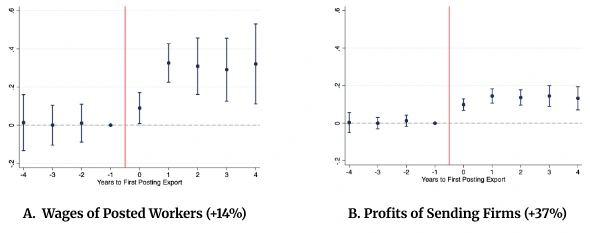
Figure 3: Wage and Profits Gains from Posting in Portugal
Notes: This figure show the evolution of posted workers’ wages (left panel) and their sending firms’ profits (right) before and after the first supply of posting services abroad (vertical red line), using administrative data from Portugal.
Second, the wage gains themselves are driven by destination-country binding minimum wages rather than by bargaining over the export surplus. Because posted workers remain employed by their company at home, employers have significant wage-setting power. In this context, destination-country regulation affects whether foreign workers capture part of the gains from trade. Without binding wage floors enforced by the EU policy, an even larger share of the surplus would flow to firms.
Policy Implications
The European experience with posting highlights several broader lessons. First, labor market integration can occur even when trade and migration are free. Temporary, firm-mediated mobility can substantially increase factor mobility even in a context of open borders.
Second, institutional design matters. The rules governing posting, including wage floors and social security rules, shape how gains are distributed between workers and firms and how domestic employment adjustment occurs in receiving labor markets.
Finally, expanding competition into previously sheltered sectors generates both efficiency gains and localized employment losses. Posting deepened integration and created new export opportunities for small service firms, but it also negatively affected employment in exposed regions.
This article summarizes ‘Trading Nontradables: The Implications of Europe’s Job-Posting Policy’ by Mathilde Muñoz, published in The Quarterly Journal of Economics in February 2024.
Mathilde Muñoz is at the University of California, Berkeley.