
Summary
Ride-hailing platforms like Uber and Lyft calculate prices based on the length of the journey, current supply and demand, and wait time for pickup. Riders are then able to decide if they want to accept the ride at the current price, wait longer for a reduced price, or opt for another mode of transportation. But what if these companies could charge riders personalized prices based on previously expressed preferences that anticipate how much the rider is willing to pay for a shorter wait time? A team of researchers explores how personalized pricing would impact the welfare of consumers, drivers, and platforms. They summarize their findings here.
The abundance of consumer data raises the prospect that digital platforms will be able to use it to personalize prices. In theory, this will enable digital platforms to identify the maximum amount a customer is willing to pay for a good or service and set the price at that amount. Ride-hailing companies like Uber and Lyft already adjust prices based on current demand with “surge pricing.” They also offer a “wait and save” option for riders who prefer to pay less and wait longer for pickup. It does not require a large leap of the imagination to anticipate these platforms using consumer data to tailor pricing to how riders have expressed a willingness to pay for shorter wait times in the past.
The researchers use data from Liftago, a Prague-based ride-hailing platform that matches riders to licensed taxi drivers via a rapid auction, in which drivers submit bids in response to riders’ ride requests. The researchers use this data to measure how sensitive each rider is to higher prices and longer wait times, allowing them to estimate how much they are individually willing to pay for a shorter wait.
The researchers then devise three counterfactuals to understand how consumer, driver, and the platform’s welfare would change under different pricing mechanisms. Under a uniform-pricing mechanism, the platform’s profits nearly triple, while consumer welfare decreases by a third and drivers’ profits drop by about 75%. The core reason is that under the current auction system, the platform does not leverage its market power to dictate prices. When the platform leverages its market power, the prices the platform would set would be more than the cheapest bids offered by drivers under the current system, and often more than what many riders are willing to pay. The result is fewer completed rides.
Personalized pricing based on consumers’ sensitivities to price and wait times benefits platforms and drivers compared to uniform pricing. More rides are completed, platform profits rise by about 8%, and drivers’ profits rise by 13%. Consumer surplus falls 2-3%, but 62.5% of riders are actually better off, as the burden falls on those riders who don’t mind paying more for shorter wait times. When pricing is based just on wait time preferences, platform profits rise by about 1% and total welfare increases by about 0.8%, compared to uniform pricing. Consumer surplus does not change. A final counterfactual that uses estimated wait times but no consumer data has comparative results to the use of consumer data to set prices based on wait-time sensitivities.
The researchers’ findings suggest that market power, rather than the use of consumer data to personalize prices, is what explains most of the decrease to consumer and driver welfare under alternative pricing systems. In fact, personalized pricing can improve welfare when the platform exercises its market power to set prices.
Main article
Digital platforms from Amazon to airline websites increasingly mediate everyday commercial transactions, and in doing so they accumulate detailed consumer data that allow them to charge customers different prices based on the maximum amount they are willing to pay for a good or service. Ride-hailing is a natural place to explore the impact of what economists call personalized pricing on consumers and workers: platforms like Uber, Lyft, and DiDi already set prices algorithmically and adjust them frequently to balance supply and demand. The addition of historical data on how customers choose rides, and under what conditions they do so, could be used to tailor prices to individual customers.
Some state governments and consumer protection advocates fear personalized pricing will allow companies to squeeze consumers’ wallets. In economics, consumer welfare refers to the difference, or surplus, between the maximum amount a consumer is willing to pay for a good or service and what they actually pay (producer welfare for a single transaction is the difference between what a seller earns on a sale and the least amount at which they were willing to sell their good or service). If a consumer is willing to pay 20 dollars for a ride home and pays only 15, their surplus is five dollars. In theory, personalized pricing will inform digital platforms the maximum amount a consumer is willing to pay and allow them to charge accordingly. This would minimize or outright eliminate consumer surplus and maximize producer welfare. Such a development would harm consumer welfare, but is this fear well-founded? Our research addresses what actually happens when a platform personalizes prices: who gains, who loses, and what happens to total welfare.
Setting and data
In our paper, published in Econometrica, we study Liftago, a Prague-based ride-hailing platform that matches riders to licensed taxi drivers via a rapid auction. When a rider requests a trip, nearby drivers submit bids that combine a price and an estimated wait time. Riders then choose from a menu of options with different prices and wait times, car types, and driver ratings—or decline them all.
Our dataset covers 1.9 million ride requests and 5.2 million bids made between 2016 and 2018. These requests and bids were made by 114,000 riders and 1,455 drivers, respectively. Because the same riders appear many times, we can recover individual-level differences in how riders trade off wait time and money, and thus how different pricing schemes would change overall demand and the distribution of consumer surplus.
Using detailed ride-hailing data, we can recover individual-level differences in how riders trade off time and money – and trace what it means for pricing, welfare, and platform design.
Figure 1 illustrates the trade-off riders face between cheaper rides with longer wait times and faster but more expensive options. More often than not, riders pick the cheapest ride over the fastest one, although this gap narrows during work hours, when riders choose the fastest option almost as frequently as the cheapest one. Because these raw choice frequencies also depend on how much prices and wait times vary across the offered options, the estimated demand elasticities discussed below provide the cleanest comparison of riders’ underlying sensitivities.
Figure 1: Trade-offs between price and wait time by hour
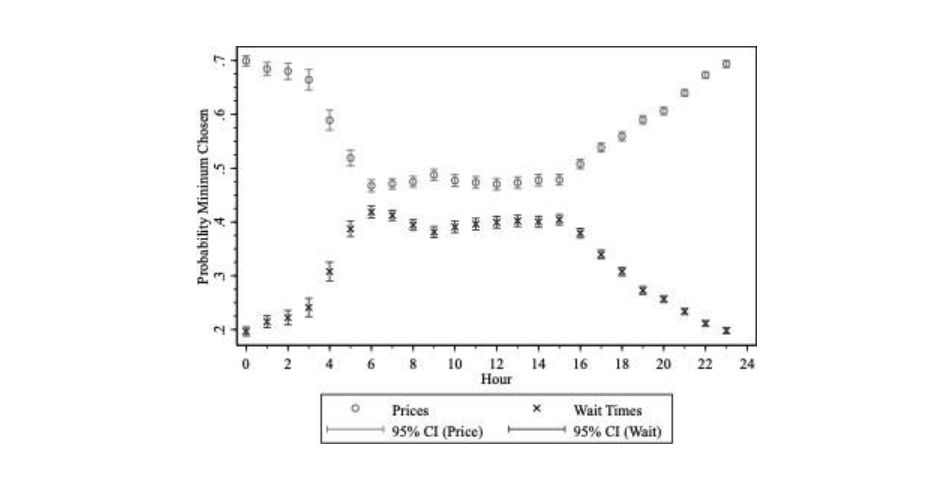
Note: This figure shows the mean probability of a rider who faces a trade-off between price and wait time choosing either the lowest price or shortest wait time. Probabilities are computed among orders in which one of the bids was chosen over alternative options.
Measuring the value of time
The model we use to capture this trade-off assumes that each rider has their own sensitivities to price and wait time, together summarized through their “value of time” (VOT). VOT is defined as the ratio of the marginal disutility of an extra minute of waiting to the marginal disutility of paying more, expressed in dollars per hour.
This framework produces three main findings. First, riders are significantly more sensitive to prices than to waiting, with estimated price elasticities (the decrease in their demand for rides in response to a 1% change in price) ranging from four to ten times larger than wait-time elasticities (the change in demand due to a 1% in wait time). Second, the average VOT is approximately 14 dollars per hour and fluctuates between 13 and 16 dollars, depending on the time of day. This VOT sits well above the average wage in Prague and reflects that riders generally earn more than the average local wage. Finally, there is substantial variability in riders’ preferences. Those in the top quartile of VOT have a VOT about 3.5 times higher than those in the bottom quartile. Specifically, the quartile most sensitive to wait times and least sensitive to price values time at roughly 23 dollars per hour, whereas the most price-sensitive quartile averages under five dollars per hour.
The average rider values time at about $14 an hour—about 50% higher than average wages in Prague —and the top quartile values it 3.5 times more than the bottom.
VOT varies by hour, skewing higher during morning and daytime hours, as well as for trips in the city center compared to the periphery. However, most of this variation is ultimately driven by individual differences rather than observable factors like time or location.
Figure 2 illustrates the distribution of individual-level preferences across price and wait time. It shows that there is only weak correlation between the two.
Figure 2: How riders differ in sensitivity to price and wait time
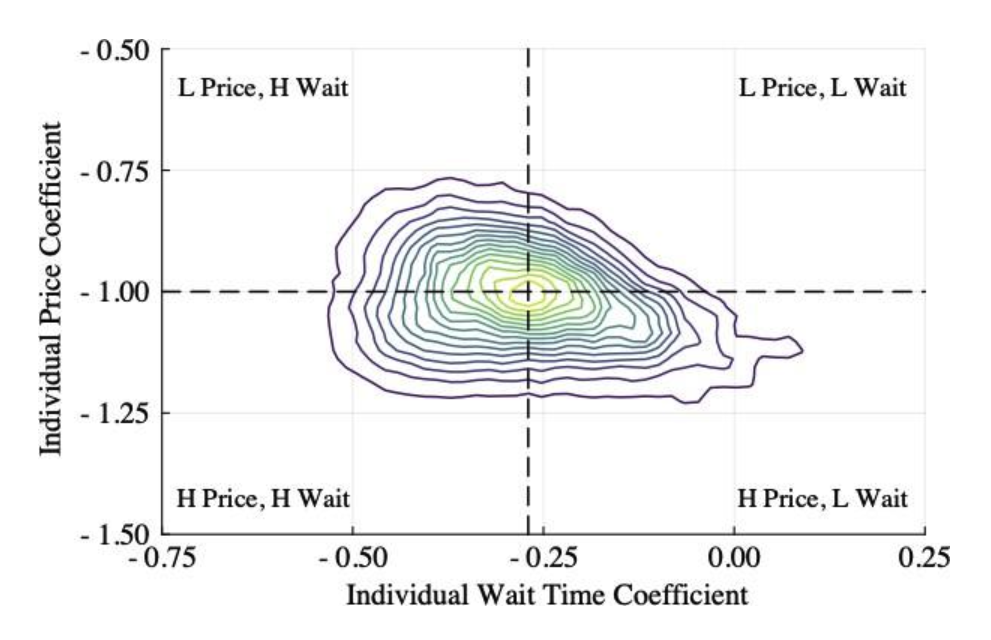
Note: The concentric contours show how riders make trade-offs between prices (vertical axis) and wait times (horizontal axis). More negative values indicate greater sensitivity. The two sensitivities are only weakly correlated, so riders fall into four loose groups: low price sensitivity with high or low wait sensitivity, and high price sensitivity with high or low wait sensitivity.
On the supply side, drivers’ bids arise from costs that combine current and future foregone opportunities—the opportunity cost—on and off the platform: drivers might make just as much from another, shorter trip, or prospective earnings may not be worth as much to them as spending time with their families. We infer drivers’ costs from observed bids and estimated winning probabilities. Drivers earn revenue above costs (markups) of about 30 percent on average. While bids and markups vary widely across drivers and trips, the underlying opportunity costs are much more consistent than riders’ VOTs. This asymmetry is what makes personalization on the consumer side the main driver in the counterfactual pricing systems we consider.
How other pricing systems would impact welfare
Currently, Liftago charges a 10% fee on the winning bid and transfers the rest of the payment to the driver. The platform does not set consumer prices directly. Instead, the rider chooses from a menu of bids offering different prices and wait times, as well as car types and driver ratings. To explore how alternative pricing systems would impact the welfare of all parties, we consider three counterfactuals.
The main threat to consumer and driver welfare may come from ride-hailing platforms’ ability to centralize and decouple prices for both parties, not just from the use of consumer data.
The first is uniform pricing, where the platform sets a single price and driver payment for each trip based on drivers’ costs, but does not consider individual riders’ preferences.
The second involves personalized pricing based on VOT-related parameters, which sets prices that depend either solely on an individual rider’s willingness to wait or on both their willingness to pay and willingness to wait. In both instances, personalized pricing is based on the customer’s previous, recorded preferences.
Alternatively, the platform could tailor pricing to each offer’s estimated time of arrival to the customer’s pickup location (ETA), setting higher prices for offers with shorter wait times. An ETA-based pricing system would charge all customers the same price for a trip depending on its ETA, and not consider individual customers’ willingness to pay for shorter ETAs.
Two levels of comparison matter for these counterfactuals. The first is how each counterfactual’s impact on welfare compares to the current auction system with a 10% fee. The second is to compare the second and third counterfactuals to the uniform-pricing system. We use the uniform-pricing system as an intermediate counterfactual between the current auction system and the personalized-pricing and ETA systems to tease out the role of market power, which occurs when the platform suppresses choice and takes a larger share of the payments compared to the auction system. In this article, we will just compare the personalized pricing systems to uniform pricing to highlight the distinctive impacts of market power and personalized pricing. In our paper, we provide an expanded comparison of personalized pricing to the auction system.
Auction vs uniform pricing
Under uniform pricing, we find that platform profits nearly triple compared to the current system, jumping from around 0.42 million to 1.17 million dollars. At the same time, consumer surplus falls by about one-third, and the share of ride requests resulting in a completed trip drops significantly from 62.6% to 47.1%. Drivers are also negatively impacted, with their profits dropping sharply—by about 75%—as the platform reduces how much of each payment goes to them while simultaneously raising consumer prices and reducing demand.
Importantly, the reduced welfare for consumers and drivers is due to the market power of platforms. Under the current auction mechanism, customers choose from a menu of bids. Under uniform pricing, this menu is eliminated, and ride offers become more expensive on average. At the same time, the platform is able to reduce the amount of each payment that goes to drivers. The uniform-pricing scenario reveals that under the current system, Liftago does not leverage its market power to the fullest extent possible.
Our paper clarifies that debates about personalized pricing on ride-hailing platforms need to focus on both market power and how they distribute gains and losses across riders and drivers.
These figures assume drivers don’t leave the platform, thus reducing the supply of labor, because Liftago accounts for a small share of drivers’ total earnings. So, unilateral changes made by the platform are unlikely to push drivers to leave the platform in the short run. At a larger platform, or over a longer horizon, a comparable cut to driver transfers would likely prompt them to switch to outside options, dampening the platform’s predicted gain.
Ultimately, this shift to uniform pricing represents the largest counterfactual diminishment of both consumer and driver welfare. It demonstrates that the largest decrease to consumer and driver welfare arises from the platform exercising market power through the centralization of prices and decoupling them from riders’ preferences. When, instead of decoupling prices, the platform both exercises market power and personalizes prices, welfare can actually increase for all parties, highlighting the central role of market power as the determinant cause of lower welfare.
Uniform vs personalized pricing
Conditional on the platform already utilizing its market power through the uniform-pricing policy, personalized consumer prices have surprisingly moderate effects on consumer welfare but meaningful effects on total welfare and the distribution of gains and losses. When the platform personalizes on both price and wait time, the platform’s profits rise by roughly 8% relative to uniform pricing. Furthermore, drivers’ profits increase by more than 13%, indicating that drivers share significantly in the gains from personalization. This leads to an overall welfare increase of about 5% compared to uniform pricing, a shift driven by slightly lower average prices and a modest expansion in the number of completed trips.
Average consumer surplus falls by around 2-3% relative to uniform pricing. However, this average loss masks significant variability in how personalized prices impact consumers, as illustrated in Figure 3, showing consumer welfare under personalized pricing relative to uniform pricing as a function of their price and wait-time sensitivity.
About 62.5% of riders are actually better off under personalized pricing. The most price- and wait-time sensitive riders gain the most, with welfare rising nearly three-fold compared to the uniform-pricing scenario. On the other hand, the least sensitive riders see their welfare cut roughly in half as the platform isolates them and marks up their rides.
Figure 3: Personalized pricing produces clear winners and losers among riders
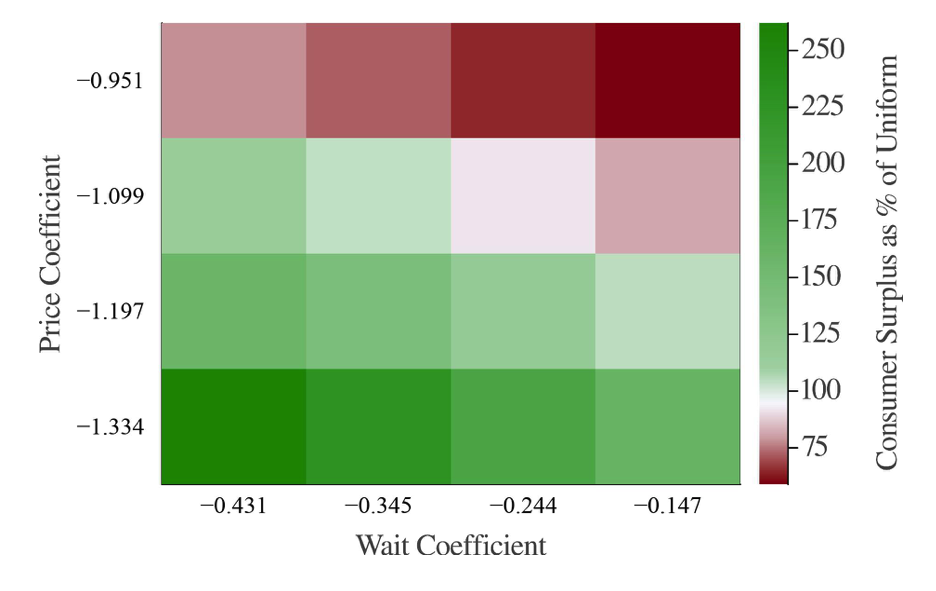
Note: Each cell shows the percentage change in consumer surplus when the platform moves from uniform pricing to personalized pricing. Riders are grouped by quartile of price (vertical axis) and wait-time (horizontal axis) sensitivity. More negative values indicate greater sensitivity. The four corners therefore correspond to the four quadrants of Figure 2. The lower-left cell – high price and high wait (H Price, H Wait in the figure) comprises riders highly sensitive to both price and wait times. This cell sees their surplus rise nearly three-fold as the platform lowers prices to retain them. The upper-right cell (low price and low wait) comprises riders insensitive to both. These riders see their surplus cut roughly in half as the platform isolates them and marks up their rides. Overall, about 62.5% of riders gain under personalization.
[Compared to uniform pricing,] about 62.5% of riders are actually better off under personalized pricing. The most price- and wait-time sensitive riders gain the most, with welfare rising nearly three-fold.
Conversely, when personalization is restricted to wait-time only, the effects are notably smaller. Under this approach, the platform’s profits rise by about 1% and total welfare increases by about 0.8% relative to uniform pricing. Consumer surplus remains essentially unchanged, and the share of completed trips increases only slightly.
Ultimately, in both personalized regimes, average fares are slightly lower than under uniform pricing, but the distribution of prices becomes much more dispersed: highly price- and time-sensitive consumers receive lower prices, while consumers less sensitive to price are required to pay more. That personalized pricing improves welfare for most riders, drivers, and the platform compared to the uniform-pricing systems shows that the main detriment of counterfactual changes to welfare is not personalized pricing but market power.
ETA-based pricing
The last counterfactual considers ETA-based pricing, which charges more for shorter waits but does not use individual consumers’ history to anticipate how sensitive they are to longer wait times. This system captures much of the benefit of exploiting variation in wait-time preferences. Platform profits rise by about 0.7–0.9% relative to uniform pricing, which is roughly two-thirds to almost all of the gain achieved by using personalized wait-time preferences.
Overall, total welfare under ETA pricing is close to that under a system that personalizes prices based only on wait-time preferences, and consumer welfare slightly exceeds that under uniform pricing. Because ETA pricing does not use consumer data to personalize prices, it may be more palatable in settings with strong privacy concerns. This is the system that Uber and Lyft currently use when they offer “wait-and-save” options.
Policy takeaways
The paper delivers three broad messages for researchers and policymakers thinking about personalized pricing on platforms:
The first is that the main threat to consumer and driver welfare may come from ride-hailing platforms’ ability to centralize and decouple prices for both parties, not just from the added use of consumer data. Once a platform exercises market power, using more information about preferences can increase total welfare, with gains going to consumers and drivers.
Second, personalized pricing has important distributional consequences. Most riders gain modestly, but the riders least concerned about prices (i.e., the least price-elastic riders) can be targeted with higher prices and experience substantial welfare losses, while drivers can appropriate a surprisingly large share of the incremental change in total welfare. Lastly, simple, non-personalized menu designs based on wait time (ETA-based pricing) can replicate much of the profit and welfare gains from more data-intensive personalization, offering a potential compromise between efficiency and privacy.
For economists, regulators, and competition authorities, our paper clarifies that debates about personalized pricing on ride-hailing platforms need to focus on both market power and how they distribute gains and losses across riders and drivers.
This article summarizes “Personalized Pricing and the Value of Time: Evidence from Auctioned Cab Rides” by Nicholas Buchholz, Laura Doval, Jakub Kastl, Filip Matějka, and Tobias Salz, published in Econometrica in May 2025.
Nicholas Buchholz is at Princeton University. Laura Doval is at Columbia Business School. Jakub Kastl is at Princeton University. Filip Matějka is at CERGE-EI. Tobias Salz is at MIT.
References
Buchholz, Nicholas, Laura Doval, Jakub Kastl, Filip Matějka, and Tobias Salz. 2025. “Personalized Pricing and the Value of Time: Evidence from Auctioned Cab Rides.” Econometrica 93, no. 3 (May): 929–958. https://doi.org/10.3982/ECTA18838