Summary
The palm oil industry has lifted incomes in Indonesia and Malaysia, while also generating major carbon emissions through slash-and-burn deforestation. Green trade policy can substantially reduce those emissions at low cost. More broadly, this research suggests that trade policy has broad scope to reduce global carbon emissions—especially for polluting industries where a large share of production is traded, where there is a high degree of concentration at the country level, and where demand is inelastic. Effective green trade policy must be coordinated across markets, credible over the life of firm investments, and designed with the welfare and incentives of producing countries in mind.
A long-running debate around trade policy is whether importing countries should intervene when weak domestic regulation has climate consequences beyond national borders. Palm oil makes the question unusually stark. It is ubiquitous, with uses ranging from cooking and baking to cosmetics and biofuels, and land clearing for plantations has driven large-scale deforestation, releasing vast amounts of carbon. In Hsiao (2026), I look at the potential for trade policy to curb palm oil-related emissions in Indonesia and Malaysia, which produce 84% of the world’s palm oil.
To quantify the potential gains from green tariffs on palm oil imports, I estimate how consumer demand and producer supply respond to prices, and therefore how palm oil producers respond to price changes. I feed these estimates into a dynamic model of the world palm oil market and also use spatial data to translate plantation development into emissions. I conduct policy simulations to ask how a range of regulatory interventions would have changed production, emissions, and economic welfare.
The benchmark is direct regulation. A coordinated 50% production tax in Indonesia and Malaysia reduces emissions by 7.4 gigatons. It raises world prices and lowers consumption abroad, and it reduces producer profits at home. Yet Indonesia and Malaysia gain overall. Because they supply most of the world market, the higher world price shifts part of the tax burden to foreign consumers, while their governments collect the tax revenue. Direct regulation remains difficult in these countries, however, since mills and plantations are widely dispersed, posing challenges for monitoring and enforcement.
Import tariffs are less direct. A tariff applies only to traded palm oil, leaving consumption in Indonesia and Malaysia untaxed. Still, coordinated and long-run tariffs of comparable intensity reduce emissions by 5.4 gigatons. Inclusive of transfers that compensate Indonesia and Malaysia for their losses, the cost to the EU is only $15 per ton of carbon dioxide—suggesting that there is room to pursue both climate goals and distributional fairness.
These gains depend on both coordination and commitment. Under a 100% tariff, for example, EU action alone reduces emissions by only 0.7 gigatons, while coordinated action by all importers reduces them by 5.4 gigatons. On the commitment side, emissions are sunk once forests have been cleared and plantations established. An importing government then has an incentive to remove the tariff—and forward-looking producers to continue to invest. Even a policy sustained for a decade has much smaller effects than one credibly maintained over the full length of the 30-year study period.
Green trade policy should take care, however, to preserve—not crowd out—domestic incentives to regulate. If Indonesia and Malaysia impose export taxes, then revenue accrues to producing countries rather than importers. Export taxes also spare domestic consumers and require enforcement only at international ports. Furthermore, foreign consumers share in the tax burden because Indonesia and Malaysia have pricing power. If foreign governments already tax imports, however, a domestic production tax falls more heavily on consumers and producers. A carbon border adjustment mechanism addresses the problem by crediting domestic regulation.
The broad lesson is that not every polluting industry should face the same tariff. This research suggests, however, that trade policy has broad scope to reduce global carbon emissions—especially for polluting industries where a large share of production is traded, where there is a high degree of concentration at the country level, and where demand is inelastic. Effective green trade policy must be coordinated across markets, credible over the life of firm investments, and designed with the welfare and incentives of producing countries in mind.
Main article
A global climate problem
The European Union is preparing to implement its Regulation on Deforestation-free Products at the end of 2026. The regulation covers palm oil alongside cattle, cocoa, coffee, rubber, soy, and wood, and it requires firms to show that covered products do not come from recently deforested land (European Commission 2026). This policy resurfaces a long-running debate: when weak domestic regulation has consequences beyond national borders, should importing countries intervene?
Palm oil makes the question unusually stark. It is ubiquitous, with uses ranging from cooking and baking to cosmetics and biofuels. Indonesia and Malaysia produce 84% of the world’s palm oil and account for 89% of exports. The industry has fueled economic growth and lifted millions out of poverty, especially in rural Indonesia (Edwards 2026).
Temporary regulation does little to change long-lived investment.
At the same time, land clearing for plantations has driven large-scale deforestation. The most consequential losses occur in swampy peatland forests, which house deep layers of carbon-rich peat. Farmers drain the swamps and clear the peat by slashing and burning, releasing vast amounts of carbon in the process. As shown in Figure 1, carbon emissions from Indonesian and Malaysian palm oil amounted to 5.45% of global emissions between 1990 and 2016—more than the emissions of the entire Indian economy over the same period.
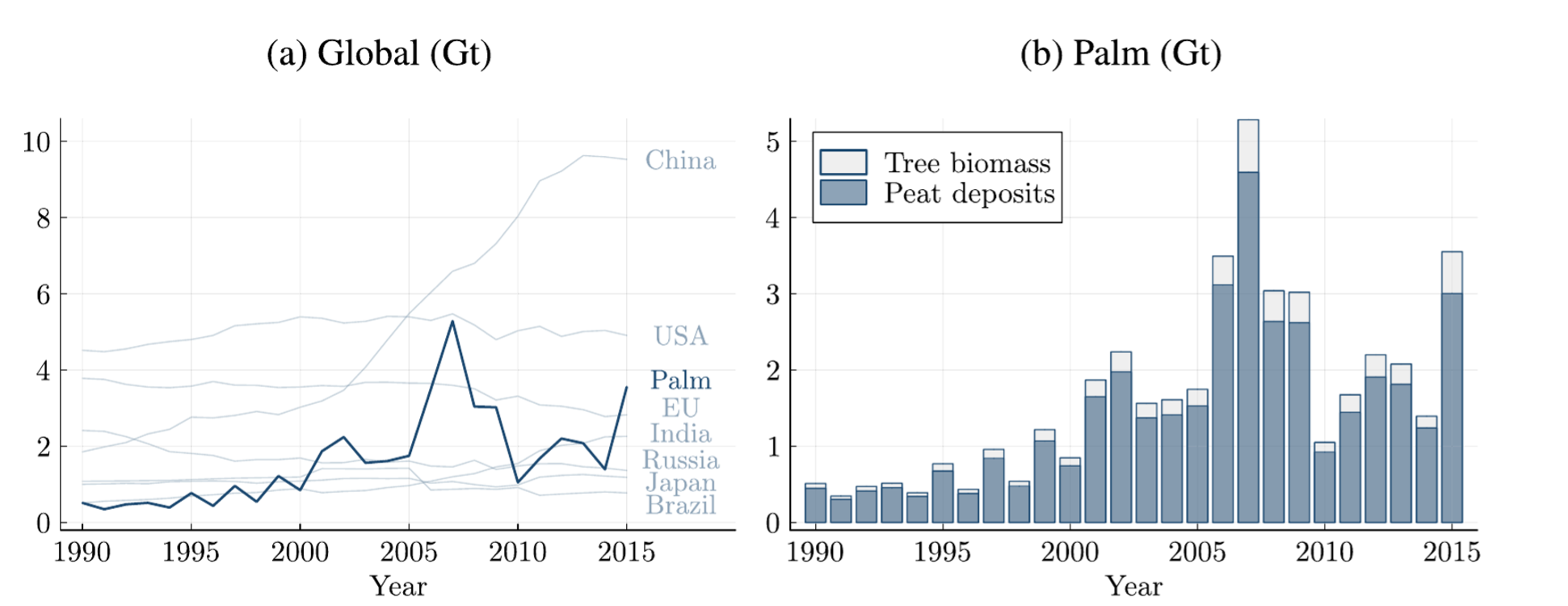
Figure 1. Palm oil emissions, 1990–2016. The left panel compares emissions from Indonesian and Malaysian palm oil with emissions from the largest emitting economies, including land-use change. The right panel separates palm emissions from tree biomass and peat deposits. Emissions are in gigatons of carbon dioxide. Source: Hsiao (2026), using Climate Watch (2020).
Direct regulation remains difficult in Indonesia and Malaysia. Mills and plantations are dispersed across a sprawling rural landscape, posing major challenges for monitoring and enforcement. Past regulation has also struggled: Indonesia’s 2011 moratorium on new forest concessions did little to curb deforestation (Busch et al. 2015).
Trade policy offers an alternative. It allows foreign governments to reduce the prices that carbon-intensive producers receive in world markets, without directly monitoring production abroad. In Hsiao (2026), I quantify the potential gains from green tariffs on palm oil imports.
Measuring demand and supply
The first step in this quantification is to estimate how consumer demand and producer supply each respond to prices. These responses determine whether trade policy reduces deforestation or merely redirects palm oil toward unregulated markets.
For demand, I assemble annual data on prices and consumption for vegetable oils in each major consumer market worldwide. I estimate how changes in palm oil prices lead consumers in each market to substitute between palm oil and other vegetable oils.
For supply, I construct a panel dataset that records the expansion of palm oil production in Indonesia and Malaysia from 1988 to 2016. Satellite maps identify the exact locations of palm oil mills and plantations. I combine these data with measures of palm oil yields, transport distances, tree biomass, and peat deposits to capture the substantial spatial variation in output and emissions in this setting.
I use these data to estimate how palm oil producers respond to both short- and long-run price changes. The estimates reveal a sharp distinction between the two. Oil palm takes three years to bear fruit and can remain productive for decades. Thus, producers respond weakly to a temporary policy if they expect prices to recover before new plantations mature.
From estimates to policy
I feed these demand and supply estimates into a dynamic model of the world palm oil market. For any given policy, the model captures how taxes change world prices and consumption, how producers respond by changing plantation investment, and where that development occurs.
The spatial data on tree biomass and peat deposits allow me to translate plantation development into emissions. I also calculate how the economic gains and losses are divided among consumers, producers, and governments. I conduct policy simulations to ask how a range of regulatory interventions would have changed production, emissions, and economic welfare over the study period.
The benchmark is direct regulation. A coordinated 50% production tax in Indonesia and Malaysia reduces emissions by 7.4 gigatons. It raises world prices and lowers consumption abroad, and it reduces producer profits at home. Yet Indonesia and Malaysia gain overall. Because they supply most of the world market, the higher world price shifts part of the tax burden to foreign consumers, while their governments collect the tax revenue. The same broad finding holds for production taxes of varying intensity (see Figure 2); increasing abatement amplifies welfare losses for the EU, China, India, and other importers, while Indonesia and Malaysia experience welfare gains. Direct regulation can therefore reduce emissions while raising national welfare, even before counting the climate benefit.
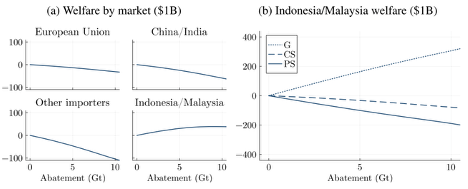
Figure 2. Production taxes. I simulate coordinated, long-run production taxes of increasing intensity by Indonesia and Malaysia. I plot effects on market-specific welfare and total abatement from 1988 to 2016. Abatement is palm emission reductions. Welfare is in billions of inflation-adjusted, year-2000 USD, and abatement is in gigatons of CO2. Welfare for Indonesia and Malaysia includes consumer surplus, producer surplus, and government revenue. Welfare elsewhere includes consumer surplus.
Trade policy has broad scope to reduce global carbon emissions.
Import tariffs are less direct. A tariff applies only to traded palm oil, leaving consumption in Indonesia and Malaysia untaxed. Still, coordinated and long-run tariffs of comparable intensity reduce emissions by 5.4 gigatons. Inclusive of transfers that compensate Indonesia and Malaysia for their losses, the cost to the EU is only $15 per ton of carbon dioxide.
These gains depend on both coordination and commitment.
- Coordination: When only the EU imposes tariffs, lower world prices encourage consumption in China, India, and other unregulated markets. Under a 100% tariff, EU action alone reduces emissions by only 0.7 gigatons, while coordinated action by all importers reduces them by 5.4 gigatons.
- Commitment: Emissions are sunk once forests have been cleared and plantations established. An importing government then has an incentive to remove the tariff: the tariff burdens consumers, but it cannot restore the forest. Forward-looking producers anticipate this temptation. If they expect regulation to end, they continue investing. Even a policy sustained for a decade has much smaller effects than one credibly maintained over the full length of the 30-year study period.
Green trade policy relies on both coordination and commitment.
Impacts and incentives
Import tariffs impose large losses on Indonesia and Malaysia, where palm oil supports livelihoods as well as government revenue. Compensating transfers can recognize that these countries provide global ecosystem services when they curb deforestation. I find that coordinated tariffs remain inexpensive for the EU, even when their cost includes transfers that leave other markets no worse off. These results suggest that there is room to pursue both climate goals and distributional fairness.
There is room to pursue both climate goals and distributional fairness.
Indonesia and Malaysia can also impose export taxes. For traded goods, export taxes and import tariffs apply to the same palm oil shipments and thus create the same incentive to reduce production, but the revenue accrues to producing countries rather than importers. Export taxes also spare domestic consumers and require enforcement only at international ports. Furthermore, foreign consumers share in the tax burden because Indonesia and Malaysia have pricing power as dominant producers. Export taxes can raise their welfare independent of climate concerns.
Import tariffs weaken this domestic incentive to regulate. If foreign governments already tax imports, then a domestic production tax falls more heavily on consumers and producers in Indonesia and Malaysia. A carbon border adjustment mechanism addresses the problem by crediting domestic regulation: as Indonesia and Malaysia raise production or export taxes, importing countries reduce the border charge. This credit preserves producing countries’ ability to pass some of the cost to foreign buyers and, with it, their fiscal incentive to regulate. The EU carbon border adjustment mechanism relies on similar incentives to encourage foreign regulation (Clausing et al. 2026).
Beyond palm oil
Hsiao (2026), which focuses on one industry—palm oil—complements broader work on whether trade policy can mitigate climate change (Farrokhi and Lashkaripour 2025). The broad lesson is that not every polluting industry should face the same tariff. Three market features determine the broader effectiveness of green trade policy.
First, trade policy has greater reach when a large share of production is traded. Indonesia and Malaysia export roughly 80% of their palm oil. In other domains, Brazil exports a much larger share of soy than of beef, and global trade accounts for a much larger share of crude oil production than of coal production. Border measures will have correspondingly different scope.
Second, concentration matters at the country level. Palm oil production is not concentrated among firms—the largest producer accounts for only 4% of global output—but it is highly concentrated between Indonesia and Malaysia. This concentration makes coordination among producers more feasible and gives them market power. It also means that policy designed without them is likely to be less equitable and less durable.
Third, how strongly buyers and producers respond to prices determines who bears the cost of regulation. When demand is inelastic, producing countries can shift more of the burden of an export tax onto foreign buyers. Producers, meanwhile, respond strongly to prices over the long run because they can change where and how much they invest. Commitment to long-run policy can discourage development and deforestation, but short-lived policy cannot.
The estimates come with qualifications. The model does not capture trade disputes or the diplomatic bargaining required to coordinate tariffs and transfers. In practice, trade policy must navigate important political constraints, both domestically and internationally.
Green trade policy should preserve, not crowd out, domestic incentives to regulate.
Nonetheless, trade policy has broad scope to reduce global carbon emissions, especially in traded markets with concentrated production and inelastic demand. Effective green trade policy must be coordinated across markets, credible over the life of firm investments, and designed with the welfare and incentives of producing countries in mind.
This article summarizes “Coordination and Commitment in International Climate Action: Evidence from Palm Oil” by Allan Hsiao, published in Econometrica in February 2026.
Allan Hsiao is an assistant professor of economics at Stanford University. He studies environmental policy, trade, and economic development.
References
Busch, Jonah, Kalifi Ferretti-Gallon, Jens Engelmann, Max Wright, Kemen Austin, Fred Stolle, Svetlana Turubanova, Peter Potapov, Belinda Margono, Matthew Hansen, and Alessandro Baccini. 2015. “Reductions in Emissions from Deforestation from Indonesia’s Moratorium on New Oil Palm, Timber, and Logging Concessions.” Proceedings of the National Academy of Sciences 112(5): 1328–1333.
Clausing, Kimberly, Jonathan Colmer, Allan Hsiao, and Catherine Wolfram. The global effects of carbon border adjustment mechanisms. 2026.
Edwards, Ryan. 2026. “Export Agriculture and Rural Poverty: Evidence from Indonesian Palm Oil.” Journal of International Economics 159: 104209.
European Commission. 2026. “Regulation on Deforestation-free Products.” Directorate-General for Environment. Accessed 15 August 2026. https://environment.ec.europa.eu/topics/forests/deforestation/regulation-deforestation-free-products_en.
Farrokhi, Farid, and Ahmad Lashkaripour. 2025. “Can Trade Policy Mitigate Climate Change?” Econometrica 93(5): 1561–1599.
Hsiao, Allan. 2026. “Coordination and Commitment in International Climate Action: Evidence from Palm Oil.” Econometrica 94(1): 1–33.